5 Must-Reads from Paul Graham’s Essay & Bonus Insights on Gates, Musk, and Jensen Modes
If you’ve never been part of a successful startup — or better yet, founded and led one — this concept might seem challenging to grasp. But when you think about it, the logic is clear: Founder mode is not manager mode. As a founder, knowing your solution in depth is non-negotiable if you want to inherit the future.
For centuries, kingdoms thrived on rigid hierarchies, and armies perfected the art of command chains, convinced that these structures were essential for maintaining order and control. But in the world of startups, you’re not in the business of order and control — you’re in the business of innovation. And innovation thrives not by following old rules, but through bold questioning and meticulous execution.
As Abraham Lincoln wisely said: “The dogmas of the quiet past are inadequate to the stormy present. The occasion is piled high with difficulty, and we must rise with the occasion. As our case is new, so we must think anew and act anew.”
At the latest YC event, Brian Chesky’s talk was so captivating that even Ron Conway, one of Silicon Valley’s top super angels, forgot to take notes for the first time in his life. This sparked a crucial question:
Why were founders consistently given the wrong advice on how to scale their companies, despite all the well-meaning intentions?
Let’s dive into these golden insights together. These insights will equip you to thrive in a world that will soon no longer exist.
#1. Conventional Wisdom Can Mislead
“Hire good people and give them room to do their jobs.”
Brian Chesky followed this advice, with disastrous results. He found a better way by studying Steve Jobs, and ,obviously, it’s working brilliantly.
At the event, top founders revealed the same shocking truth: the advice meant to help them nearly derailed their companies.
But why?
Here is why in Paul Graham’s words:
“What they were being told was how to run a company you hadn’t founded — how to run a company if you’re merely a professional manager.
But this m.o. is so much less effective that to founders it feels broken.
There are things founders can do that managers can’t, and not doing them feels wrong to founders, because it is.”
#2. Understand Founder vs. Manager Mode
Founder mode:
Hands-on and closely involved.
Manager mode:
Focuses on delegation and treating departments as separate units.
Seems like a modular design, treating departments as black boxes.
They give instructions but avoid getting involved in the details to avoid micromanaging.
Until now, many believed that scaling a startup meant switching to manager mode.
That’s just plain wrong.
Credit: Garry Tan
#3. Founder Mode: A New, Often Misunderstood Concept
It’s a more direct, hands-on leadership style, like Steve Jobs’.
This approach may break traditional rules, like only dealing with direct reports, but it helps maintain innovation as a company scales.
It’s clear this will break the rule that CEOs should only engage through direct reports.
It’s so unusual that it’s called “skip-level” meetings.
#4. Don’t Adapt Ineffective Management Styles
Founders often feel gaslit by advice to run like managers
and by employees when they deviate from the norm, pressuring them to adopt less effective management styles.
Instead, experiment to find what works best in your unique context.
Trust yourself.
This is one of the rare exceptions where everyone seems to disagree with you.
“VCs who haven’t been founders themselves don’t know how founders should run companies…” — Paul Graham
#5. Study Steve Jobs’ Way
Steve Jobs held annual retreats for Apple’s 100 most important people, not just those highest on the org chart.
Can you imagine the force of will it would take to do this at the average company?
Imagine how powerful this could be — making a big company feel like a startup.
Steve Jobs wouldn’t have continued these retreats if they didn’t work, yet few companies do this.
Is it a good idea or not? We still don’t know — that’s how little we understand founder mode.
Bottom Line:
Founder mode is more complex than manager mode, but it delivers better results. We still know so little about founder mode.
Founders have already achieved so much despite bad advice. Imagine their potential once we can guide them to run companies like Steve Jobs, not John Sculley.
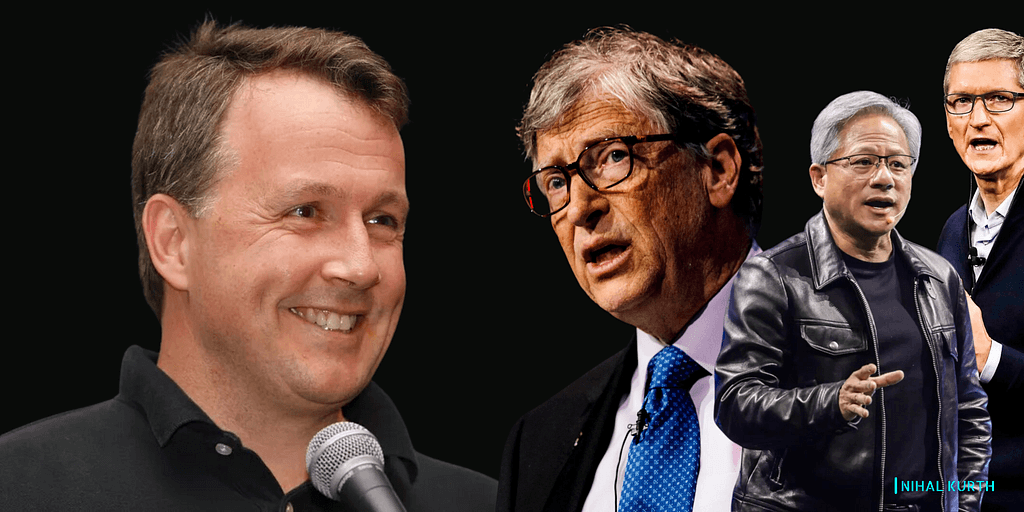
BONUS 1: Jensen Huang’s “Founder Mode”
Jensen’s Algorithm:
Optimizes for flat organizations to ensure information travels quickly.
Currently, he has about 40 direct reports, but he never holds any one-on-one meetings with them.
Moreover, when he needs to communicate a strategy change or anything that has a significant impact on the company, he addresses everyone at once and keeps his door open for feedback to refine the approach further. Why talk to just one person when it concerns everyone? This approach exemplifies zero hierarchy in action.
From an NVIDIA Employee:
“The other anomaly is that Jensen talks all the time with ICs doing the work. I was only a couple of months into working at the company before I got to have a face to face discussion with him about a project I was working on. I have seen many mid-level engineers (IC4-IC5) give him deep dives in these group meetings.
It can be very stressful being under Jensen’s microscope, but it dramatically reduces the “let’s show pretty slides to the CEO to show him everything is good” BS. I was previously at a startup 1/100th of this size where the CEO was far less connected to rank and file engineers, so it has been a really nice change.”
BONUS 2: Bill Gates’ “Founder Mode”
Even in the 1990s, Bill Gates was still personally reviewing every major feature at Microsoft.
With only six management layers, the company was far less bureaucratic than it is today.
Gates read every spec page, jotting notes in the margins.
It wasn’t about the spec document; he was gauging if the person had control. He’d push with tougher questions until they admitted they didn’t know — then he’d call them out for being unprepared.
Fun fact: The number of times Bill dropped the F-word was a measure of the meeting’s success.
BONUS 3: Elon Musk’s “Founder Mode”
Here’s a glimpse into an unpublished email Musk sent to Tesla employees years ago. This email reveals his mindset and approach, emphasizing the importance of being direct, efficient, and hands-on. In Musk’s view, the “chain of command” has no place in teams where logic and proactive problem-solving are paramount.
Subject: Communication Within Tesla
There are two schools of thought about how information should flow within companies. By far the most common way is chain of command, which means that you always flow communication through your manager. The problem with this approach is that, while it serves to enhance the power of the manager, it fails to serve the company.
Instead of a problem getting solved quickly, where a person in one dept talks to a person in another dept and makes the right thing happen, people are forced to talk to their manager who talks to their manager who talks to the manager in the other dept who talks to someone on his team. Then the info has to flow back the other way again. This is incredibly dumb. Any manager who allows this to happen, let alone encourages it, will soon find themselves working at another company. No kidding.
Anyone at Tesla can and should email/talk to anyone else according to what they think is the fastest way to solve a problem for the benefit of the whole company. You can talk to your manager’s manager without his permission, you can talk directly to a VP in another dept, you can talk to me, you can talk to anyone without anyone else’s permission. Moreover, you should consider yourself obligated to do so until the right thing happens.
The point here is not random chitchat, but rather ensuring that we execute ultra-fast and well. We obviously cannot compete with the big car companies in size, so we must do so with intelligence and agility.
One final point is that managers should work hard to ensure that they are not creating silos within the company that create an us vs. them mentality or impede communication in any way. This is unfortunately a natural tendency and needs to be actively fought.
How can it possibly help Tesla for depts to erect barriers between themselves or see their success as relative within the company instead of collective? We are all in the same boat. Always view yourself as working for the good of the company and never your dept.
Thanks,
Elon
Final Words
Watch the magic happen when you code these insights into reality.
I hope these insights equip you to thrive in a world that will soon no longer exist.
To all the founders out there, here’s to you! May your marathon meetings and countless pitch decks suddenly transform into those overnight successes we all dream about — and maybe even a unicorn or two. 🦄✨
Hey there! I’m Nihal, an engineer turned product strategist with a strong background in B2B dynamics and a proud Included VC Fellow. With entrepreneurial roots and work experience across 14 countries, my focus is on helping founders build products and teams that matter. Curious about the mind behind the keyboard? Let’s connect — drop me a line!
Fun fact: I launched my first business at just 12 years old.
From code to character: What a $500 Robot Gets Right About AI// A $500 robot just did what billion-dollar AI demos couldn’t. Reachy Mini shows us why: One head tilt. One blink. One giant leap for lova...
The viral chart nearly everyone read wrong.// 3–4 min read · A single chart convinced the internet that students run AI. One deeper look that rewrites the story.First appeared in Essentialist Edge · A...
Begin Before Anyone Believes — Be It Deep Tech or MountaineeringFrom death zones to a YC-backed $21M orbital bet: decoding conviction in deep tech.Disclaimer: I’m not a space expert. I didn’t grow up...