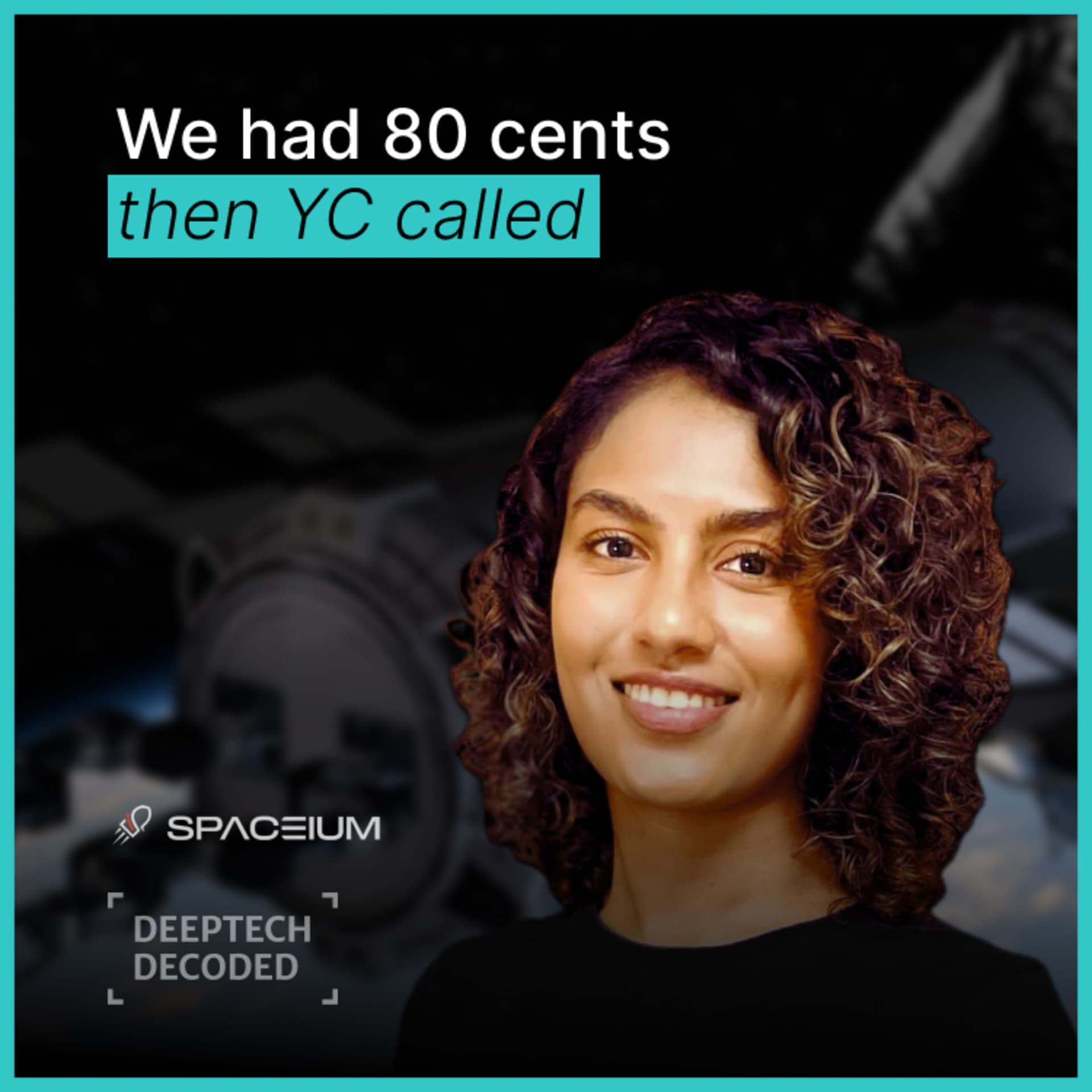
Spaceium builds unmanned stations that refuel and repair spacecraft in orbit.[1]Launch YCSpaceium: Automated space stations that refuel and repair spacecraft in orbitYC, Jun 17, 2024[2]Y CombinatorSpaceium company profileYC Its cryogenic technology stores and transfers propellant with zero loss, and a proprietary modular robotic arm transfers fuel to any spacecraft design.[2]Y CombinatorSpaceium company profileYC Ashi specializes in orbital mechanics and rocket propulsion.[2]Y CombinatorSpaceium company profileYC[1]Launch YCSpaceium: Automated space stations that refuel and repair spacecraft in orbitYC, Jun 17, 2024 She has worked on aerodynamic models for NASA and real-time simulation models for uncrewed asteroid return missions, and has built rocket engines, payload structures and recovery systems.[2]Y CombinatorSpaceium company profileYC[1]Launch YCSpaceium: Automated space stations that refuel and repair spacecraft in orbitYC, Jun 17, 2024 She and Reza met leading the University of Ottawa's rocketry team.[1]Launch YCSpaceium: Automated space stations that refuel and repair spacecraft in orbitYC, Jun 17, 2024[3]Deeptech DecodedAshi Dissanayake on meeting Reza on the university rocketry team (40:25)Episode Spaceium (YC S24) reports $86.1M in binding commercial contracts, a further $230M in the pipeline and $1B in letters of intent.[2]Y CombinatorSpaceium company profileYC It raised a $6.3M seed round led by Initialized Capital in January 2025.[4]TechCrunchY Combinator grad Spaceium raises oversubscribed $6.3M for space re-fuelingPress, Jan 23, 2025[5]PayloadSpaceium Closes $6.3M Seed RoundPress, Jan 24, 2025[6]SpaceiumSpaceium Closes $6.3M Seed Round to Build Refueling Stations in SpacePress release, Jan 22, 2025
Decoded before it's obvious.
Ashi Dissanayake is the co-founder and CEO of Spaceium, which builds automated stations that refuel and repair spacecraft in orbit.[2]Y CombinatorSpaceium company profileYC She specializes in orbital mechanics and rocket propulsion, and has built aerodynamic models for NASA and hardware including rocket engines, payload structures and recovery systems.[2]Y CombinatorSpaceium company profileYC[1]Launch YCSpaceium: Automated space stations that refuel and repair spacecraft in orbitYC, Jun 17, 2024
A Y Combinator S24 company building fully automated, unmanned service stations in space.[2]Y CombinatorSpaceium company profileYC[1]Launch YCSpaceium: Automated space stations that refuel and repair spacecraft in orbitYC, Jun 17, 2024 Its long-term plan is a network of stations along the route from Earth to the Moon and Mars, so missions can carry more payload and travel further.[2]Y CombinatorSpaceium company profileYC[7]Deeptech DecodedAshi Dissanayake on refueling on the way to the Moon and Mars (22:10)Episode
Cryogenic fuel storage and transfer that keeps extremely cold propellant with zero loss in space, and a proprietary modular robotic arm that can transfer fuel to any spacecraft design rather than to one docking standard.[2]Y CombinatorSpaceium company profileYC[1]Launch YCSpaceium: Automated space stations that refuel and repair spacecraft in orbitYC, Jun 17, 2024
Launch vehicles, orbital transfer vehicles, moon landers and other spacecraft that benefit from more payload capacity and longer range.[2]Y CombinatorSpaceium company profileYC
The company reports $86.1M in binding commercial contracts, $230M more in the pipeline and $1B in letters of intent.[2]Y CombinatorSpaceium company profileYC
An oversubscribed $6.3M seed round led by Initialized Capital, announced in January 2025, with Y Combinator among the other investors.[4]TechCrunchY Combinator grad Spaceium raises oversubscribed $6.3M for space re-fuelingPress, Jan 23, 2025[5]PayloadSpaceium Closes $6.3M Seed RoundPress, Jan 24, 2025
Last updated Oct 23, 2026