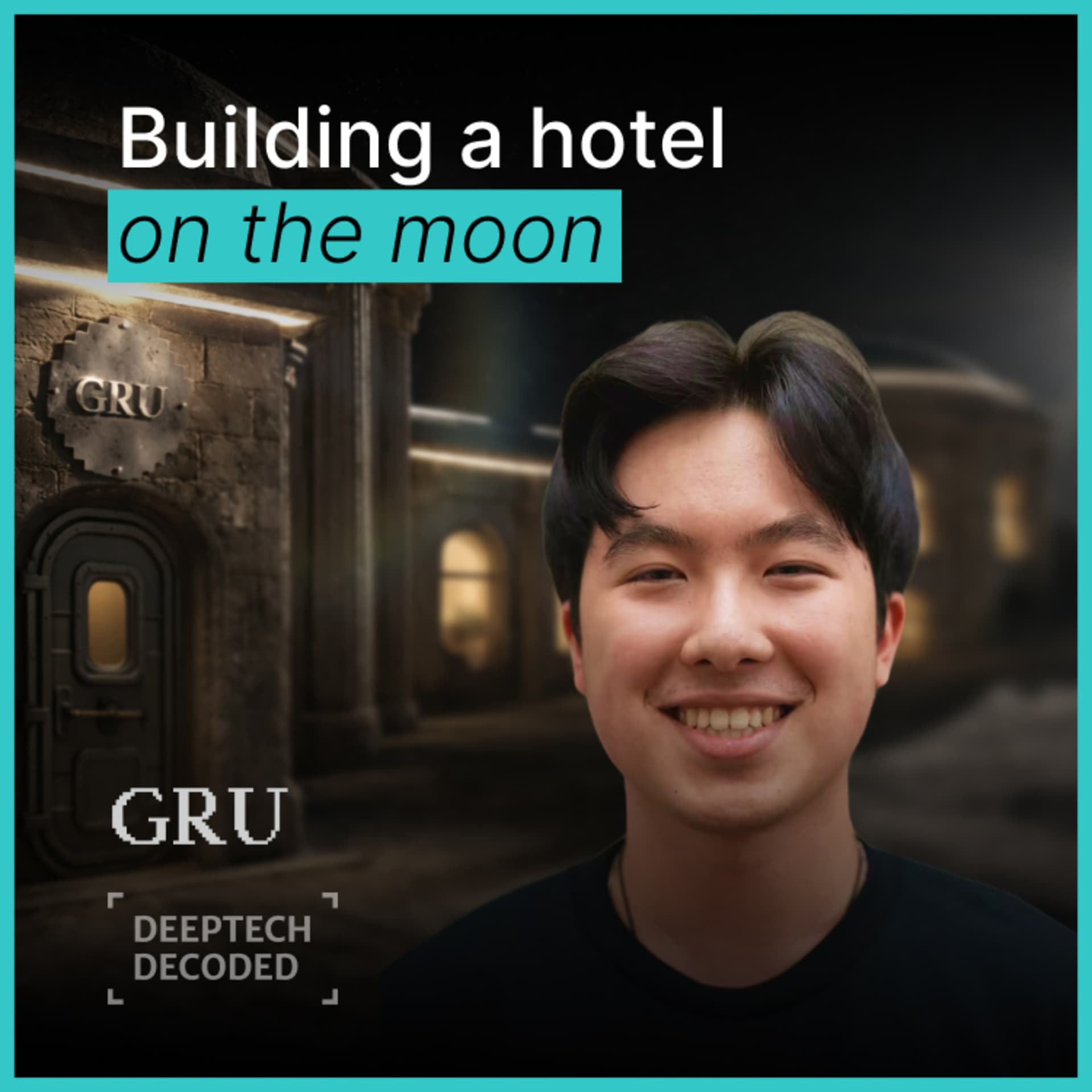
Moon Hotel Trojan Horse: 1st Bricks of a Type III Kardashev Civilization | Skyler Chan, GRU Space

The reasoning layer
Decoded before it's obvious.
Transcript
So Skylar, actually, ⁓ you pick something. Like normally there are heart problems, but there are also heart problems. Like you pick something on civilization level. First, maybe like why don't we try to go back to the time and where you started to grow with this idea and then you said, I cannot not work on this. Like this needs to be my...
Mm-hmm. Yeah, thanks for having me again, Neil. And yeah, happy to share the story. yeah, for me, like it was actually pretty natural. ⁓ I've always wanted to become an astronaut since I was three growing up. I was very obsessed with space like most kids, but that never really went away. ⁓ I decided that I wanted to go down the road of becoming an astronaut. And so I basically poured everything I could into trying to, you know.
build myself up towards that career. And so when I was 16, I had the opportunity to learn how to fly aircraft, Comox Air Force Base, really fun experience. But coming back from the program, I did some reflection and I realized like, hey, it felt, you know, was going deep into like, what is like the most meaningful thing that one could do in our generation, right? In this moment of human history. And I thought to myself, well, Okay, this is a very traditional or not traditional very like, hey, this person did it and I have to follow his path. But that's like really not how I guess, achieving the greats really works where you have to kind of your own path and really affect the most amount of positive change in the world. I think it comes down to enabling everybody to experience something right. And so I realized like, okay, well, I wouldn't really be fulfilled if I just went up there and you know, came back down like I feel like we all we want to move humans to the moon and Mars. I felt like a calling to that. We have to make humanity interplanetary. And keep in mind this is in high school. And I was like, well, it seems like the world is heading towards an exciting future, right? Where transportation is going to be solved at some point. And I was watching the Falcon rockets. I was watching the developments with, I remember when NASA Mars Rover landed. just like, there's a lot of kinds of stuff that was happening, right? And so ⁓ pretty optimistic and inspired kid, I was like, well, I felt that the most meaningful thing to work on is to make humanity interplanetary, you know, if I have time. And so I went down the list through, you know, I kind of like sketched it. I was trying to figure out like, what are the problems that haven't been solved? Yeah. And so it is still down to the
I mean, I think it's transportation, communications, like power, you know, and obviously off-world surface habitation is like the thing that everything kind of converged back towards. I became very obsessed over it. was like, well, if we send robots to the moon and Mars, like, why can't we send more complex systems to enable us to live on the moon and Mars? ⁓ And so it's like, you know, that is the most exciting thing. I mean, think about it, right?
the Promethean moment that's blocking us from exploding on the moon and Mars is until we solve off-world surface habitation, we get this exciting future. ⁓ And so, yeah, it's like, I know, it's like, I guess the short answer, and there's a lot of things we could jump into this. I just want to wrap it up so that you can ask the next question, but it's like, it's an existential thing. Yeah, yeah, I mean, thanks. Yeah, it's an existential thing, right? It's like every time I was working on something else, whether that was...
during Berkeley or interning somewhere, these kinds of things. The only thing I could think about was, geez, we need to do this. I don't want to be 50 years old and be like, okay, now I'm going to working on habitation on the Minoans. I feel like at that point, this is not something that will be able to be pretty short. This is very important problem, but it's extremely, you can't quantify the impact is my point.
It's like when humans sail to the West or when humans have always gone to explore and expand that's like the fundamental thing in our DNA as a human species right from the inception of like evolutionary thing, but it's like When we sail to the West like nobody thought that well This is going to be a very valuable piece of land and like the ability to develop the technology to construct things in this very valuable piece of land which is now North United States America
that compounds that compounded like crazy, right? I mean, imagine if you could build or invest in like the foundations of New York City or San Francisco or any big city ⁓ where a lot of people live. And so it's it's like we're coming at that cusp where it's like, yeah, in the beginning, it's hard. Most people are like, well, no, it's like the Overton window has increased, ⁓ which is what we've seen with, I believe.
But also I have a feeling the personality trait is also as important as what you can bring as technically capable at the same time, because you are someone who literally say sky is no longer the limit. Like guys, this is over. And this is also in a round. You told me when we spoke previously that I'm ready to die on the sea of like, want this to make the reality. And then I want to go after that.
Then again, coming to that, really I'm trying to get the gist of the origin story. When you formulated this picture in your head, because everything you had done is obviously rotating around this too in Berkeley, even the communities that you built, the initiatives that you had, the project that you worked on. Then who did you call? Like when you say, you know what, I am going for this. I don't know if you ever pivoted on the way, but at least. The seat was there. Who did you call? And then afterwards NYC came in and everything started to a ripple effect expand.
Mm-hmm. Yeah, I remember. Yeah, one of the first people I guess I called was a mentor and also an advisor of the company, ⁓ Dr. Robert Lillis. He's ⁓ worked on really some cool space stuff at Space Dines lab. I was at one point working on Space Dines lab and ⁓ actually I got in contact with him when I started the Mars Habitat Club ⁓ at Berkeley because actually
That was just a way for me to work on what eventually became Roo or just explore that. But he was kind enough to call me as a science advisor for the club, right? And kind of advise on, you know, different science stuff that I learning and figuring out around Mars related projects, very high level description. And yeah, it's like, I remember being like, hey, I think it's a time that we turn, not turn the club, but like, you know, I work.
something that's actually going to accelerate us to live on the moon and Mars. at the time I was like figuring things out still, but I'm very grateful that people like him encouraged the early days, or least like helped shape the way I was thinking about the problem. And frankly, yeah, most of my friends, while I was like...
I mean, I was going to graduate early, right? And obviously they wanted me to stay like, you know, for the full four years and like we had the trips plan and stuff. But I kind of went in like monk mode. I remember it was like, like March, April, like when I just like started skipping all my classes and I just like sat, I was literally in my room every single day, like just writing. I'm like, it was tough. I just writing out like my thoughts and the thesis and like all these different things. ⁓ I have like a notes folder.
Well, I have a massive crew space notes folder, but I also have like a space notes folder that has just like dates back to like, I know, I guess when I first got my iPhone, before 2020 high school and just got all these different things that I've let that, I don't know, just think about. Cause I just think about it all the time. And, and, uh, it has actually kind of led towards, um, what became this. And, I remember, oh, another thing is I was in front. coffee shop at Berkeley, Karu Coffee. And I was trying to think of a name. I was like, well, you know, the final form of this is really like the whole point, right? It's like we want to make humanity interplanetary. But it's like, what is like the key thing is like, every technology revolution, it's always been a small group of people are like, hey, let's do something full, freaking crazy. Like, let's change the way that we understand how to make use of the current status.
of technology or really resources and like elevate that to a point where it benefits a lot of people. Right. And that's like the agricultural revolution is like, well, we were able to figure out how to make use of the land. And then, well, you know, because we now we have less time, save more time from having to hunter gather and run around. We can develop land on top. And then it's like, you know, other revolutions in the industrial revolution. And it's like, well, now we figured out how to, you know.
industrialize, right? And then see AI like.com AI, etc, etc. And the whole thinking was, you know, the next thing is lunar industrialization. mean, of course, like humans are gonna go there and we're going to we can't rely on our face resources the whole time. And so everything basically centered around like resource utilization, like I sorry, specifically, but like resource utilization. So
I started using the concept of using local resources and turning it into useful material. think technology development is very in line with the economic development too. Whenever humans have figured out to do these things, sure in the beginning you have lot of people who like, no we're losing jobs, or no this is bad, or blah blah blah. But in the long run, the medieval king is living ush.
literally shittier life than what you and I are living. I mean, I'm sure their toilets were less clean. And so ⁓ it's with us. The understanding of how to use local resources on the moon and Mars is going to compound and it's going to lead to this explosion of things that you can do that we just couldn't think about. And then I was like, well, lunar resource utilization.
Mm, that's can't really pronounce it, right? I was like, okay, well, I like Mars, like Mars, or some M Roo, like, and then eventually, I was trying to think like bigger and bigger. And I was like, well, the final form of this is, is really to to hit like, type three on the car ship scale, right? Which is crazy, I know to think about but the galactic resource utilization. Okay, sounds pretty good. And then I was with my friend, and he was like, holy shit, like, Roo.
Hmm. Well, fun fact is actually that came out of necessity when we launched, which I'm very grateful for and I'm happy, know, I believe space is for all, right? We got so much inbound and like, I just like, I don't know where to put them, right? So was like, hey, like, you know, just, okay, I've been making minion role and just put your resume there and you know, maybe at one point we'll look at it, but yeah, it's a...
Yeah. And then now actually speaking of the seriousness, your white paper is actually a little bit different than any other white paper I ever read in a way it's really very encouraging and still puts the human element into this. Like, because in the end of the day, it's always belief, right? Like if you want to, if you believe in this, perhaps you don't see the next two or three steps, but you see that there's this bigger thing. I'm going to figure this out one step at a time.
If you take the romance and this excitement, enthusiasm out, can we just look at it like a system, the system that you are aiming for? And then let's this down together so that everybody is able to digest this and then we are able to highlight couple of questions. How on earth, how on moon he's going to pull this off? By the way, I'm a huge optimist.
I don't know with you. I can see all your reasonings and I see the maths and everything. But there are a couple of things like you stop and probably you have those assumptions in your head too. So let's start with the like the big, big, picture. And then I just try to break it down into how you see it. It's such a big question.
Mm-hmm. Ahem. This is great. No, that's yeah, I'll just take it. No, it's great question. Great question. No bad questions. Yeah. ⁓ first, removing all the removing all of the philosophy and all that aside. So just going bare bones. What are we trying to do? We're trying to build a whole town. Okay. Engineering wise, like what does that mean? The whole town is really a habitat on the moon. Okay. Working backwards. What exactly does a habitat on the moon have to have? You know, we've seen lots of different concepts, you know, over decades and then however much longer you would want to count. But a lot of people have thought about this, but the way that we're approaching it is in a very deliberate, like practical, like let's cut out like 99 % of the fluff. And let's just think about whatever the core technology is that we need to de-risk along the pathway so that we can actually realize this vision. Right. I think that's what differentiates serious and non-serious. And so when we're looking at the habitat, okay, what do you need to build a habitat, what you need to solve for. So I grew like, in our opinion, we're going to tackle this with four problems to solve for. The first one is the extreme. Well, sorry. First one is the vacuum of space. And so the lack of pressure on the moon is one of the first things that will kill you the moment you step off and you take off your suit. second thing is the temperature swings. We're hundreds of degrees of Celsius of temperature swings on the moon. So one lunar day is actually 14 Earth days.
It's just sunlight and then one lunar night is 14 Earth nights and just darkness. And so that's a problem. The third problem is the radiation. And so there's two types of radiation on the moon. Galactic cosmic rays and solar energetic particles. so GCRs, that bucket is like kind of in the back. You can kind of think of it as like it's always there. It's not going to kill you immediately. It's not like you have like a...
a radiation gun you're pointing at someone. But when we're talking about solar particle events, or solar energetic particles, this is where it gets dangerous. Right? And there's a lot of people who talk about storm shelters on the moon. There's a lot of different ways to solve this. that's the third bucket. Fourth bucket is micrometeorites and all the debris, but really just meteorites like impacts on the moon. So the way we thought about this is okay. What do we have to build, like engineering-wise, to solve for these problems? The first problem, the first two things is the inflatable, right? So we're building this pressurized temperature-controlled inflatable that is designed to withstand the pressure and temperature extremes on the
The second product is the brick making machine, which is going to make the first bricks on the moon, manmade bricks. And that is important for, first of all, humans have not built a product on the moon yet. So before you think about these lofty things, like let's build something on the moon. And second of all, this is used to solve for the two problems, the last two problems, right? So radiation and micrometeorites.
So when you combine these two things, you've got the inflatable inside, which is the inner bladder. And then you've got the ⁓ bricks surrounding it, which protect you from radiation and micromedites. Now, of course, there's like millions of problems that you can point to that people have to solve eventually. But you think about like the most critical path, like what are the things that we need to prove out to even get to the hotel? ⁓ This is like how we think we should be tackling it. Now.
There's a lot of assumptions at play, of course, following launch price costs that humanity will want to do this. That's inevitable, right? There's millions of different things. But that is what this is at the end of the day, right? I mean, every startup is a bet. ⁓ And this is like the most obvious bet. So yeah, let's hear a little bit about how the roadmap works.
Mm-hmm. Yes. Exactly. You get it. Yes. Wait, no, this is good. You hit it spot on. It's like I want to ask you to to to to to paraphrase our white paper. That's that's awesome thing. Thanks again for ⁓ reading it. So, ⁓ yeah, the true vision of this, the is the whole tell us is the beach. The whole tell us just the flywheel, which I know, again, like people who are not thinking about this are building this every day like we are.
It's crazy. It's not that crazy actually, because it's like this is an infrastructure play. Like what is Roo? Is Roo going to be the intraplanetary construction company? Obviously we started with the fact of Moon Hotel Company. If you Google Moon Hotel, we're the only ones that show up for like 30 pages straight. ⁓ Shout out to Google, shout out to SEO. ⁓ But the next step on our master plan is we want to build a moon base. We want to build lunar infrastructure like roads. warehouses, firms, like places to do things on the moon, right? Right now it's just barren, right? But we need to develop it up. And so you think about the closest analogy again is really the construction developers who build the first cities in a new country, right? And that's really what it's going to be like. ⁓ The third step, but again, it's not just the moon, right? Like we're going beyond the moon. So where do we go after the lunar infrastructure plate? We go to Mars.
And this is important because if you think about every like empire, okay, in human history, that was like, okay, like the British Empire, Japanese Empire, guess the, you know, empire we live in today, realistically, like groups of people, you know, form countries and, you know, form like powerful nations because, well, they are probably impermeable, right? You know, you've got a moat, you know, if you're on an island, you've got a moat surrounding you and you've got a lot of protection from invaders.
Today, with the development of technology and defense technology and weaponry technology, ⁓ anybody can be hit anywhere in the world very quickly. This is, guess, a very timely thing. my point is, with Mars, you actually have a physical barrier. you can't, like, we have an outpost on Mars, right? And everything happens on Earth, like, say, World War III or something like that, right? Or, you what have you.
if we're able, assuming big assumption, but if we're able to sustain life on Mars, that is that group of people, company, country, empire. See, this is the thing is like a group of people, a company, a country, an empire, a nation, fundamentally like physics wise, we're just people, right? It's just a group of people who decide to work together towards a mission, right? So that's why I think whoever is able to build that.
But actually, is what I like the most about the way you approach this, because you are on Kardashev scale type three. You're at the utmost level ever. And you work backwards from that. It's not like I'm trying to build a software and I'm trying to work backwards from the, you know what the user needs and so on. But this is more like an entire ecosystem has so many dependencies to the other players at the same time.
but you also count on that advancements too through time. And now we are even below the first level. Like we couldn't even reach the first level and then yet we are dreaming for the top three. And then from there, okay, what is the smallest thing I can prove everyone? We are gonna get there slowly and step by step. And then the genius part form in my mind is the moment you put the goal out there,
companies started to reach out to even to put their logos on their bricks, like on the bricks that you are about to. And then all of a sudden see resources are also being generated somehow. Like it's not that I never liked the arguments around, ⁓ it's such a billion dollar industry with big players. So just start up, are they gonna pull this out? It's not like you are. having the resources of another company or family that you bring with you that you you will pump your resources in there. You kind of like kind of leverage the enthusiasm of the real believers and their resources literally not in the moon right now but first on earth perhaps did you also have this kind of wow i even didn't think about this like i even didn't think that would be you know rolling like a snowball effect going in that direction i feel like
Yeah, I gotta say, well, first of all, wait, you understand the vision. You picture pretty well too. It's, yeah, I gotta say, to your point with the launch, I was in, and as you said, people are kind of rallying together to be behind us and how can I help? First of all, I'm incredibly grateful. Don't get me wrong, zooming out, this is the dream. I feel like I'm...
living the Drucciata dream in like every possible way. Like super grateful to be able to lead in the charge towards this next exciting future, this next, I guess, generation, this next step. And ⁓ like, it's just like the amount of support and ⁓ like just everything is overwhelming and incredible. With the launch, I kind of work, you know, to kind of tell the story. mean, again, I... I just did the launch on YC and I wasn't expecting it to go global and then it hit really global. I was, I'll summarize it. Making humanity planetary is actually not a technology problem. In my opinion, it's an execution problem. It's an operational problem, right? Like we've gone to the moon before on technology, you know, less than our iPhone today. We can go again. In fact, we are going to get out of our mess and with us next.
But it's like, if you really think about it, there is no reason why humans can't do this in their lifetime, which is why we're doing this, right? It's like, there is no reason. And we just gotta start. We gotta rally together the people. And so I remember going into this, I was like, moon hotel is already such a polarizing thing, but it's able to capture the imagination of the people, the people as in the human species, global human species. And so the way that I'm thinking about it is like, Most space companies, know, as an engineer myself, like, I actually started wanting to do like robots on the moon, right? That was like, again, like with this club and all that stuff, student club, like robots are cool and you know, but the problem is it doesn't affect the average person, right? The average person can't imagine what it's like. And the moon hotel is the best way to close the imagination gap. It's also the best business case, which is crazy. So it's beautiful. ⁓ And then the second half is what you're hinting at. ⁓
Which is, if we succeed, right, in building the first hotel on the moon, like, it's a win for this whole space industry, because now there's a need for power on the moon. Now there's a need for communication on the moon so that people can FaceTime their friends and family back home. Now there's a need for robotics on the moon. Now there's a need for ATVs on the moon. Look at the LTV, like rovers. There, like a lot of these, you know,
⁓ Companies, their success is hinged upon if they can win a government contract. But with an LTV, mean, that could also be reforged as an ATV for guests. ⁓ I didn't mention this earlier, ⁓ but the core, if you look at the space industry, it's really probably by two pillars, governments and billionaire backed companies. with governments, a lot of startups who try to sell get trapped in the valley of death, quote unquote. And with billionaire backed companies.
It's hard to really, you know, again, they want to frantically integrate like where you slide into the startup. It's, hard. Um, I look at the moon, you've got a lot of groups who are trying to do engineering services. The problem is who's the real customer, right? You have to make so many people want, and there's no people in the equation. The people, you know, maybe maybe we're making something that is cool. You know, engineering and sexy and all that, but like no one's there. And so.
What we're doing is we're using space tourism, which has already proven market. Go to the moon, build the first hotel on the moon. And then it's obvious, well, now we need like, robots. Now we need communications. Now we need power to power the hotel. So I think that is probably why we've ⁓ received the response that we have.
But I think also this, you mentioned earlier either on your white paper or one of your interviews that it looks like something so ⁓ out of mind, but at the same time, if you think about it, everything that advanced the humanity came from these very other issues cause like this extremely seems like impossible and then they became the reality. like Ellen Moss is one of the living examples that showed us.
Like from even scratch you can start and then build things one step at a time. And how would that, that's why that actually, always say, deep tech is relevant to anyone. It's not just for the engineers, for the nerds or for the people who think sci-fi, near sci-fi realm, but rather it actually affects your life too. Maybe indirectly, but in the end it touches you. And then the part that I like most, you started showing this very tangible way. Then now you're taking this.
let's say extremely wealthy people that you give them a chance to come. But then I'm going to just try to understand a couple of perspectives there, starting with, say I'm one of your customers and you're going to take me, you're going to make me one of the four, right? Four or five people were on your first version one. But then the first thing that comes to my mind, NASA has a tremendous set up. and backup solutions for anything that might go wrong, anything that might not work according to the plan. Right. Let's take like step by step. I, you put me into the trainings. Probably you have collaborations partnerships that however you might maybe also like to explain us like to simulate how are we going to make this door to moon? How are you going to take? Okay. I registered. You said you're qualified. Like how are you going to qualify me? And then what sort of things I need to go through, because remember the Apollo mission and astronauts after the post mission, they came back and they coughed dark for months. Like we have so many, it's not as easy as we say, or once you cross zero gravity and then you land on the moon and also your eyes, your heart, they all get affected. Maybe you have some vision problems too, which happens to 50 % of astronauts. So yeah, I can keep the list like a little bit going. But you got my point, right? Like how do you take care of this part? Let's talk about that me and an individual, you make me ready for that mission. Because it's not like you take me to California, like from Germany.
The angle of ⁓ me going there in a healthy way and then the like I am ready to take it. And when I come back, I don't have permanent severe lung problems or heart disease or anything goes wrong up there. How are you going to intervene that or the just to be risk the things because we can talk about all things that might go wrong. Like I don't want to go in that path, but rather those really very big risk elements and how do you take care of those?
So yeah, that's actually, yeah, so I mean, those are the four things that are the things that we're solving for when we build the hotel is the four things that will immediately kill you on the moon is the pressure and temperature swings. I'm sorry, lack of pressure and the temperature swings, the radiation, right? And like MMOD, but arguably speaking, radiation is not as big of a problem as what most people think. The other thing is it doesn't matter. I had to say it, but.
the first people who are going to go, they're going to go anyways. Like, I think people, people, a lot of people, lot of normal people out there are like, Oh, like, what about like, you know, radiation is not going to hurt me. Or like, you know, like if you're going to go to explore the moon and you're going to live on the moon, like you got to realize like the people who are doing this self select already. And they're like willing to take the chance. mean, that's the important part is they're willing to take the chance to make this happen. I'm willing to take the chance to make, if I could go.
Right? It's the same thing. ⁓ so I think there's always risk. You cannot fully guarantee risk free. This is inherently ⁓ by the most dangerous thing people can do. Right? It's like, I think that kind of goes without saying. ⁓ but if you think about like, well, what is the practical path, right? To making this happen? Cause here's the issue. If you, if people, keep spinning in their circles and their academic circles and keep yapping about like, this is like how we need to do it. And you we need this and this and this like, that's never going to be done because that's just stupid. Right. And so like what we're doing is like, well, okay, like what are the things that actually are plausible? Right. What are the things that are the like 80 20, like the most important things? But yeah, you can have this like super elaborate, like it's called Eclipse, like environment control life support system.
that's able to do all these really cool things, know, passive water for this filter, blah, blah, blah. But if you don't, if you can't like prove first that you can withstand the pressure on the moon, like that's going to kill you first, not this, right? So that's how we're thinking about it is like we whittle down the most like big things that are going to hurt people on the moon. And then we think about like, like what else? Right. But I think just like with the invention of the airplane, the first flights, We're way more expensive than what you and I pay right now to go across the Atlantic, but are way also more uncomfortable and probably less safe. But that's the thing is like, you want to be the first people, if you want to be an explorer, it's inherently risky, right? If people who are like, know, oh, like, it's like, you know, not really, you know, my thing, like, well, that's fine. mean, you're not our customer, right? So and they're also just going to come later. So not a concern.
Mm. Mm. Actually, billions are not of interested people, Like, they are globally, all around the world. Remember the Dear Moon project, the Japanese billionaire that he focused on, but then for several reasons the project got hold off, like it didn't go. Do you sometimes think like, because when you take a look at that project, one of the key reasons was this timelines were constantly moving and they were not able to see when this is gonna be a reality.
How do see yourself being the prioritization for all those big companies? Because right now your transportation needs are covered. Like you can really nicely delegate. And even if this doesn't happen with SpaceX, Blue Origin is as an alternative. How do you see this not going to be constantly moving goal?
I'm not worried so much about the time, I'm just worried about how Guru's face is gonna make themselves priority so that the others are also gonna partner and open the path for you. when I checked the Dear Moon project, one of the key reasons were so many things were expectedly going wrong, but at the same time, it didn't become the priority of the collaborators who were going to make this a reality.
Mm-hmm. Yeah, the bricks, yes. ⁓ It's in our lab over there. We've, yeah, so we've developed in like literally six weeks, we've developed a prototype in our lab that is designed to make the first, world's first bricks on the moon. ⁓ It's the MVP version of it. So the next step, the next stage is to turn that into flight hardware.
and send it through the moon, which is very exciting. And so what the machine does, it's you can kind of think of it as a black box, right? This is the first product that we have. Actually, we've got a product video, launch video, second launch that's coming very soon. stay tuned for that. But the machine is basically it minds the regular pulls it into our proprietary process, which is patent pending, and then it makes the first bricks on the moon. The other half of this is the inflatable. And so, like I said, in our roadmap, right? Well, what do we need to do to actually do all this and de-risk is like, well, we need to build the most meaningful technology demonstration. That's your next step. Test it on the actual moon. mean, in space engineering, there's a thing called flight heritage, right? NASA has this ranking system called TRL, technology readiness level. Essentially, you're as a space company, you want to like move that up as quickly as possible. You look at star cloud, they're the first guys who like did that data center demonstration in space, right? And that obviously ushered in a whole new era of stuff going on, which is really cool. ⁓ but more importantly, it actually did the thing. I mean, that's kind of the same sense is like when space engineering, you want to prove quickly, ⁓ and meaningfully that you're
the most basic version of your technology works in the actual environment. you know, people can keep talking in circles about like, well, we need to do it this way, or we need to do it that way or whatever, but like, doesn't freaking matter until we actually go to the moon and do the thing, right? Like nobody has any grounds of saying that we have to do it this way or we can't do it this way if they haven't even tried or done it on the moon. And so for us, like that's what the machine is for, right? Well, what do need to do next as well? We're going to send that machine, that box to the literal moon and make film the world's first bricks being made. Humans first bricks being made on the moon. It's like the Stonehenge moment. And it's going to be insane. I can't think of any other milestone that is more exciting than this. And this is just the first step, you know? So, um, yeah.
So, um, oh, you mean like, is the first version, do you have the, oh, I guess, oh, you're asking if like, yeah, yeah. Um, so the first mission, mission one, so we have four missions generally planned. Mission one is we send around 10 kilogram payload to the moon. Uh, we make the first bricks on the moon and we deploy the inflatable. Mission two is we go to lunar cave base, right? Uh, and we do a bigger version of this. Uh, we scale up. Uh, lunar cave is the reason why is because It provides natural shielding from MMOD and radiation. It just means like you have to build less bricks, right? It's just cost. Mission 3 is a bigger version of this. So this is the first hotel.
That's mainly going to be earth-based materials, but we're going to transition. I think that's the important part is in the science community, like, ISRU, people are always like, well, we have to do 100 % ISRU, like we have to melt and laser stuff on the moon. But that's stupid because that takes orders to maintain more energy than what you'd actually be able to do practically speaking, right? We don't have acres of solar panels and acres of solar radars out there. ⁓ The second angle is... And then the second half of the debate with ISRU is you've got people who are like, well, we got to use everything from Earth to the Moon. we got to bring it, ISRU doesn't make sense. Like, you know, we have to bring all Earth-based materials. The important thing is with GRU is we see the transition of humans going to the Moon and Mars. It's not going to be hinged upon either side of this polarized debate. It's a false dichotomy. We're going to need a transition of like, okay, like some percentage and some percentage, but working together.
Maybe it's a naive question because I read around the part that have you actually tried to make the nature of the moon scent in a more workable way. I forgot the name that on the paper that you mentioned, but then it becomes more robust. Do you ever literally touch the moon scent? It's just out of curiosity.
Mm-hmm. Mm. You mean scent or the, ⁓ like rocks. ⁓ so yeah, we've seen, obviously we've worked with it before. ⁓ Like our first founding member of technical staff, ⁓ professor Kevin Cannon, he's worked with this stuff, obviously with the Apollo samples. ⁓ The synthesis synthetic, it's basically called lunar regosimulans is the actual material that we're working with in the mission in the lab over there. And that is.
obviously not real from the burn, but it's the same material. And so the reason why we can do this is because we've studied scientists like Kevin have studied this and have determined like the best way to reproduce the same contents so that we can do tests like this. That's the benefit of this all. Yeah.
I spent a lot of time just basically going around the industry and talking to people and learning. And, you know, at the end I was like, who else should I meet? Right. And it kind of just converged towards him. ⁓ And we had a great conversation. Funnily enough, the first thing I was working on was mining robots on the moon. you know, he was actually at a different company and signed an LOI for it. And it was basically my first customer. Turned from first customer to first hire. And yeah, it's awesome. know, we had an interview in DC with Laura Trump, I had interview with DC with Laura Trump on Fox News ⁓ last week. the model, we have this hotel model that we'll show later too, but it's, it got delayed five days. And so he actually booked the last minute. My interview is at 12 PM on Tuesday and it was supposed to arrive like.
many days before that, but my flight left Sunday night to DC. so Monday night it arrived. We booked like a ticket last minute. He picked up, he got the thing, flew across the country from San Francisco to Washington, DC. We met up at the hotel right before I hopped in the car to go to the Fox News headquarters and film with Laura Trump so that it would show up in the segment. I think that's the thing is this is the same thing with everyone on our team is like.
The of working on something as existential as this is that people under, it's self-selecting. There's nothing else anybody would want to work on, including myself, obviously including myself. ⁓ It is so, we can't stop thinking about it. That's the thing, I talked to my friends who are in the batch or whatever, it's it's team culture is we build moon hardware. How freaking cool is that? What is your team culture? I go skiing, ah-ho.
It's a Sunday and we're all here, like, you know, we're building moon hearts. Like, I don't think people realize, like, outside, like, the time of the world that we live in, like, this is, this is like the moment in history. Like, we're building the foundation for civilization on the moon and Mars. And so I think it's just like, it's mission driven is kind what I'm getting at, is the classic Silicon Valley term. Everyone is just like, it's magnetic, and I guess energy is there.
And I think it doesn't take you so much to figure this out. Like immediately when you sit down and start having a conversation, then there you also get the sense whether you want to spend another 10 more, 15 more minutes to explore further or not. Because this thing that you feel it in your heart before your head, like if the person is really driven to that. I am so much enjoying the conversation, but at the same time, I know Cameron has a couple of questions for you too. Let's just, ⁓ yes, you might Cameron.
Okay, just do that. And in the mean while, then I'm going to pose the question. Yeah, it's coming from Matthew Sutton. He's an investor, private investor. Also, he's helping entrepreneurs in Harvard University to make their dreams true. So his question is, what is the moment that played the most important role on directing your life's journey? How has it shaped you?
Yeah, feel free to ask the question. I think deaf plays a very important role in the journey. I've had weirdly more near deaf situations than most people I think my age. ⁓ I've gone to the ER like over 20 times for allergic reactions, like anaphylactic allergic reactions. ⁓ one time I was in Korea and was like a couple days before I was supposed to turn 20. I was like intubated, they had like IV and everything. Like I was like completely like about to pass out. And this is during spring break and I only thought of two things, which is one, how sad it would be if, you know, I'm the only child my parents saw, their only child died in front of them. And number two is I didn't think about relationships. didn't think about my classes. I didn't think about midterms. I didn't think about the internship. didn't think about my friends. The only thing for some reason I thought about was like how sad it would be if I wasn't 80 years old. I woke up at my deathbed and be like, damn, at least I tried or I put people on Mars or at least I died tried.
Or I went there. And then so after obviously, I'm alive. ⁓ Came back to Berkeley and I was like, okay, we're starting the Mars Abtec Club now. Like, I don't care. Like I need to start this now. And you can't really work on. building a company when you're in college, right? But I didn't let that stop me, right? I was like, I'm gonna work on this anyways. And this is the same thing that happened to me when I was 16 at the Glider Pilot Program is I got word that someone else who actually didn't make it into the program, but did pilot training elsewhere, passed away in a mid-air collision. And we had a whole meeting in the mess hall, the cleaning officer was very intense. When you're up there in a glider, you have to make the runway 100 % of the time. There's no engine, there's no parachute. You have to execute. And it taught me at a very early age how to be, I guess, in very intense situations. I've had some near misses as well. And these things shaped the way I think about it. You have to start now. You cannot do the deferred life hunt. You have to do what you care about like now. There's no alternative. I think there's too many young people who are like, I need to do this later. I need to go work at this thing. It's bullshit. Just start now. Like, I don't understand why people wait. But you could die. We could all die tomorrow, right? For heaven's sake. And so that's the thing is like, I feel so happy about is like, if I die tomorrow, like, I'm happy. Well, I actually wouldn't be happy. But as in like, at least like we're on this trajectory. We're leading this thing. In peace. Yes.
Moments
- Learning to fly at Comox Air Force Base at 16
- How Galactic Resource Utilization became the name
- The four things that kill you on the Moon
- The hotel as a flywheel for a Moon base and Mars
- Why space tourism is the customer that pulls the industry
- A brick-making Moon factory prototype built in six weeks
- The four-mission roadmap, from a 10 kg payload to the hotel
- Near-death moments that made him start now
Keep listening
Recent conversations
20 Years of R&D. Matched in 3 Months by 2 Friends. | Advaith Sridhar, Discovered Materials • DD15
Rocket Cargo Anywhere In 15 Minutes. The U.S. Air Force Is In. | Matija Milenovic, Hop Aero (YC S26)