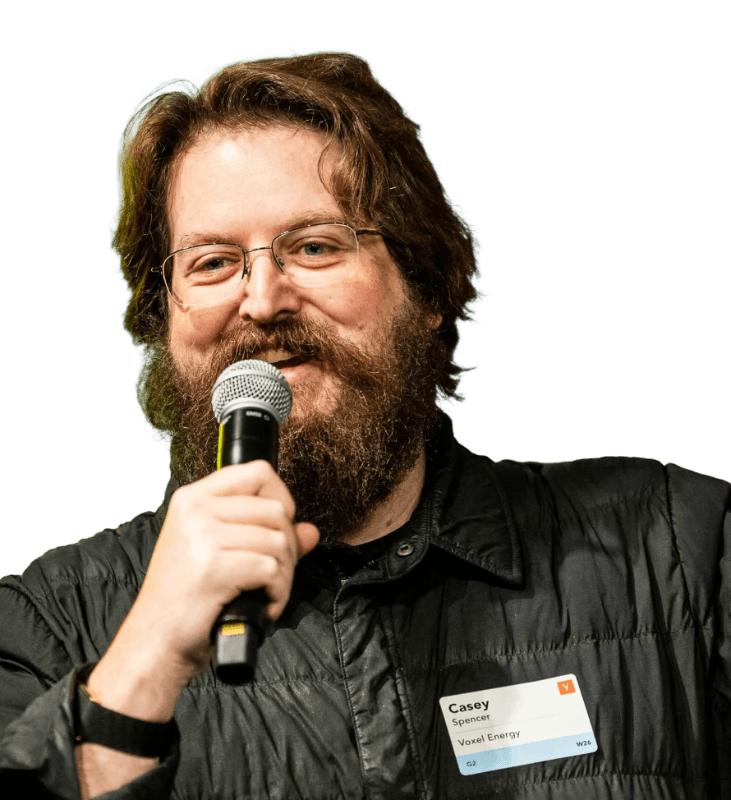
Off-Grid AI Data Centers Powered By Second-Life Tesla Batteries. Built in 200 Days. | Casey Spencer
The reasoning layer
Decoded before it's obvious.
Transcript
Hahaha Yeah, I hear that especially March, right? Like every time I'm a conversation, that is the days I do fundraise heavily. we? Okay. Fingers crossed for that. How about Kezi, you introduce yourself for the ones who haven't met you yet. As a human being first, afterwards we will go to Voxel energy as much as you like anyways.
Mm-hmm. Sure. Yeah, I don't know if I have an independent identity anymore. I don't know if I still qualify as a human being. I am a unit that ingests pizza and produces venture capital. No, but I'm Casey Spencer. I am a technologist, I guess. You know, I've been an engineer. I've been a radio host. I've won hackathons. I've been a project manager. I was project manager on Tesla Infotainment Autopilot where I was responsible for overseeing the development of Hardware 3. This was during like the Model 3 production hell and so there were days where Elon would email the engineering org saying if you aren't in Fremont somehow building cars you're fired. So there were days I would go to Fremont and
I would literally build the assembly line. literally built the rear motor sub-assembly merit cell, and then I worked on that cell. And so recently, it was pointed out to me that I'm actually responsible for having shipped thousands of Model 3s in various forms, either the autopilot stuff or other stuff, or literally hands on with the line. And that was kind of a proud moment, actually. That was contextualized literally in terms of Model 3 units. So that's a pretty proud milestone of mine. But I've got hyper-miling milestones. I had the longest distance driven in a single charge in a Model S. In 2015, I went 550.3 miles over 26 hours. I went 22 miles an hour. I had the world record for most drag race wins in a Model S, which was in a single event, I should specify, which was 28. I've been a big Tesla fanboy for a long time, as you can tell. ⁓ And so, yeah, from top to bottom, I'm literally building them, using them, world records. It's been my life for a long time, but ultimately I left, still stayed in the space, and that's largely how I ended up where I am now. So now I am CEO of Oxle Energy. We are building off-grid data centers, and our claim to fame is that we can build a 10 megawatt data center in approximately 200 days.
Whereas if you're waiting for a grid connection, you're waiting closer to five years. so speed is the name of the game. And what enables that speed is we literally use repurposed Tesla Model 3 and Y batteries. We literally take thousands of them out of the cars, package them, and then put them on site with the data center. And we have access to such a large quantity so fast that that is our secret sauce. I just divulged it on camera, I suppose. But so I'm still...
Mm-hmm. Mm. Mm-hmm. ⁓ I... Mm-hmm. Mm-hmm. That was Young Casey's first foray into capitalism. It's been in my blood since I was born.
probably. Well, no. I mean, if we want to get like real, real granular here, when I was in like third grade, I would like write stupid, like would be comics basically, and then sell them for like a dollar a piece. in junior high, I would make like staple shooters out of mechanical pencils. I would sell those to the other kids. and then, ⁓ the lemonade stand was probably around that. time too but the lemonade stand was certainly like a large step in like actual revenue shall we say. We had a kid up on like a major intersection nearby holding like cardboard sign directing the lemonade stand and then it was almost honestly now I I was just now realized this for those of you that have gone to like in and out and there's someone waiting like in the car line taking orders ahead of the actual window that's what we did.
We had a line of cars and there was a kid up the line of cars taking lemonade orders and then passing it to us and then we'd have the lemonade pre-prepared. I would just realize that like we naturally came to like the in and out order logistics process as like 12 year olds or whatever. That's kind of crazy. Yeah, literally. All right, I'm pretty proud of that too, I guess. Wow. So yeah, I guess it's just always been in my blood. We'll call it entrepreneurship, I suppose.
you Yeah Little assembly line. I had always trouble selling something to the kids. The moment I changed my customers, my life got better. I was 12 years old. was like, she, adults? Like, half life is easier. But the motivation was not money, there was something else. But still, like, recognized, my gosh, adults are so generous.
Exactly. ⁓ actually, I really liked that story when you told me, that's why I just wanted to share it publicly to see the human part of it. Because when I check your background, you had done multiple things and the common denominator is always like self-taught and a little bit of excitement. It feels like if it doesn't excite you, you don't do it. And another highlight is also you're the very, you're the first person ever. who answered my question of what's in the Vendee book, the ⁓ Slots Talk. And you answered to my, what's the, I think my question is like more like, what's one of the books that made an impression on you? And then you write like hackathons? And like, tell me why does this come to us? So you pulled the very first hackathon for the community colleges and turned out to be really a successful one.
Mm-hmm. Mm-hmm. Mm-hmm. Yeah, I was pretty successful. Yeah, I mean, I took your question to mean what's been impactful. And I mean, like going right to the logical conclusion there, like that's hackathons. If it weren't for hackathons, I very literally wouldn't be where I am now. I first learned of them in 2014. I was going to a community college at the time, always been an entrepreneur, I guess, always been a technologist. And I didn't have a community yet. I'd been doing all this stuff in a vacuum largely. Like I'd been building drones since before you could buy them. I'd been building drones since like 2009, 2010. And I, like I said, I didn't have a community. And so I joined the community college robotics club thinking, oh, this is a robotics club. These are like real engineers. They're going to know way more than I do. And that, that just wasn't the case. I was teaching them a thing or two and I became like the drone guy and
I did, yeah. I technically was never president. I think the first time I was like vice president or like secretary or something, but largely just in one responsibility. But another member there emailed or probably not email, it's like, like, I think it could have been Facebook messenger at that point or something, sent me a message saying, hey, we're going to Hack Tech January. Do you want to go? And I had no idea what he was talking about. And he said, it's a hackathon. I still had no idea what he was talking about. And so he said hackathons are where a bunch of college students go in one place and the hack on the thing over the weekend and there are prizes and like, there's a lot of stuff to do. And I again was super apprehensive. I was thinking again, ⁓ they're going to almost so much more than me. There's like real engineering students and like, I'm just a dude. But we go there. And again, drones are unknown at this point.
which is weird to think about, but even 2014, you can't buy them, you have to make them, total unknown thing. And so I walk in and Hacktech, this took place in a large open space in Santa Monica Mall. And it felt very well, it's a lot of concrete, this was like an unprocessed like storefront, I don't know, but it was large. There was like over thousand students and engineers there. And I walk in. And I'm holding this drone for those in the know. was a DJI flame wheel F450 for those that know what that is. ⁓ Yeah. It was so it's what made DJI DJI like DJI made components for enthusiasts and then just packaged into their own drone. And now they are they are. But it was a kit with pre-made components, some of my components. But anyway.
walk in holding this drone, this quadcopter, and all eyes were on me. Because most people had never seen a drone at that point. Again, weird to think about now, but most people never seen a drone in real life. Most people probably didn't even know what a quadcopter was at that point. Not that long ago, but that's how rare they were at the time. And so I walk in, all eyes are on me. Felt like I was in a movie. Made me nervous at first, but then I sit down with the team. People start talking to us. We go through the hackathon.
⁓ I helped some other hardware companies. Someone else was playing with like a little toy thing, like a toy RC helicopter type thing. I helped them with their thing. I got a scar because I accidentally turned on the motors and it tried to take off. I was holding it down. I tried to unplug it and one of my, my fingertip clipped the spinning prop and blood everywhere. ⁓ So that was fun. Yeah. Yeah, no, no, no. It was just a little nick. It's a little nick on my knuckle here.
But a lot of fun, barely slept, bacon donuts, Alexis Ohanian was there, Donald Glover was there, the founder of Activision was there, directors from Microsoft were there. So I felt like a rock star for the first time in my life. And like, this is when like being in tech made you a rock star, like 2014, like nerd culture was very in. like, I'm not like Donald Glover was literally there and tweeting about the event. And he was saying, I'm going to have my own hackathon.
And Alexis Ohanian, co-founder of Reddit was there. I got pictures of him and he's trying other people's like projects and whatnot. ultimately did not place, did not win anything. But my life was changed and I was obsessed because what a community, what a funnel, what validation, working with other people, recontextualizing my own capabilities within that community. accessing opportunities, both in terms of again, community, also professionally. that hackathons are all I did from that point for years, I became a mainstay in the community. And eventually won that same year. So Calhacks 2014, October 2014, I won the first Calhacks with mind controlling that same drone. ⁓ and I don't want to go on too long, I suppose, but, the same friend that invited me to, I mean, I'll keep going until you tell me to stop maybe, but, ⁓ the same friend that invited me to hack tech said, okay, you know, now we're going to Cal hacks. I'm in LA at the time. and he said, I'd love to introduce you to some friends of mine that are doing a, brain computer interface. Like that's, that's their shtick. That's what they love doing. And like, maybe we could control your drone with our brains. And I was like, maybe,
I'd gone to a few hackathons between the first one and then Calhacks and hadn't won anything yet. Kind of discerned that I was trying too hard. I was caring too much and I was focusing too much on the prizes on winning. And so I determined, you know what? It's a free bus ride up to the Bay here, up to Berkeley. I'll just get a ride to the bus from UCLA and I'll ride up. I wasn't even sure if I was going to bring my drone, because it's a lot. Like, it's not just a drone. I have to bring spare batteries, spare props, the controller, electronics.
Yeah, it's quite a bit. I brought a big cardboard box and I was like, do I even want to bring that if I'm going there just to hang out? Do I even care to bring that? I was like, you know what? I'm going to regret it if I don't. And so I brought it. It's in the seat next to me up on the bus. I have a picture of it. And I meet them. They're saying, we want to control your drone with our mind. We can make it happen. I was like, you know what? Sure. If it works, great. If it doesn't,
I'm going to have a good time. And so we're working on that. I'm meeting people, I'm mingling, I'm doing some like for anyone in the hackathon community, stackathon stackers, snackathon, snackers, you already know. And I'm calling back to like, my God, 12 years ago. And so they're working on the brain computer interface. I'm handling the drone side. What we end up doing without like getting too deep in the weeds is they have an open source brain computer interface called an open BCI. They make a K nearest algorithm, K nearest neighbors algorithm where you go through training mode, you think left, you think right. And so now this reference algorithm knows what your brain looks like when it's thinking left and right. And then during the actual process, ⁓ It will constantly be trying like I don't remember how many times a second I think I'll like in the hundreds of times a second it will try to discern whether or not it looks more like your brain is thinking left or right and Then once it makes that determination it then goes through an Arduino that converts a signal left or right to PPM Which then communicates to my analog RC radio that's connected to a trainer court that just allows for external connection over like a certain sawtooth PPM pattern, which then controls the drone. So as far as my RC controller goes, it thinks there's another controller giving instruction that other controller was ultimately someone's thought. And so there's a video of this of one of my teammates with all these diodes all over his head. And he's just like completely zoned out, focusing. And you can see on my radio,
literally you can see my radio which shows like the signal input and he's focusing and He's slowly saying left left left and then the drone will eventually do this and he goes right right and it does this and The accuracy was honestly pretty good. it wasn't perfect by any means, but it was Definitely better than just 50 % we weren't just flipping a coin. It was at least 60 or 70 % and So that was great. And I mean, think I could say this now. technically didn't, nobody cares. We technically didn't finish within like the allotted time, because we were told, okay, everybody like pencils down, so to speak, stop working on your thing. You have to go outside so we can like reconfigure the venue for like demos. And so we're outside, we're waiting just outside the venue in Berkeley. I can't remember the name of the stadium, but it's Stadium Berkeley. And they're like, man, like we were so close. We were almost finished. We were like two lines away from finishing. And I said like, so finish it. Nobody's watching. Nobody cares. Like, just open your laptop to finish it. And then we'll test it on my radio and then we'll go like. So then they did. And then we did. And I could see on my radio, it was working appropriately. And so then I turned on the drone and we do the thing and some recorded video and like posted it on the hackathon hackers Facebook group. And so everyone else in the venue like saw that and like came out and watched us and like people applauded. Oh my God, that's so crazy. Cause again, drones still brand new. Someone's mind controlling one crazy stuff to see. Um, and then I'll try to truncate a little bit. That was October, 2014. Yeah. Yeah. Um,
I wouldn't call it a startup. That was just me building drones. was people that every now and then come to me like, I want to do this thing, that thing. Like that was not a startup. That was never VC funded. Like that just paid for books every now and then. Like, yeah, that was just like a personal thing. But then, yeah, then I started doing Tesla stuff. I ultimately would mind control a Tesla. I did the Tesla world records and then
I went to this program that I'd be surprised if anybody in here has heard of called Make School. And they're a college alternative. They're like a glorified boot camp basically. And I was introduced to them via hackathons. They started marketing through hackathons. And while I was there, met them, was interested, I got into Make School and UC Irvine at the same time. thought, everyone tells me when I go to real college, my life will be totally different, life will be great. And so I go to UC Irvine, don't like it, decide to go to make school instead via make school, get into Tesla. Here we are. So if not for hackathons wouldn't be here. Yeah, they are now defunct.
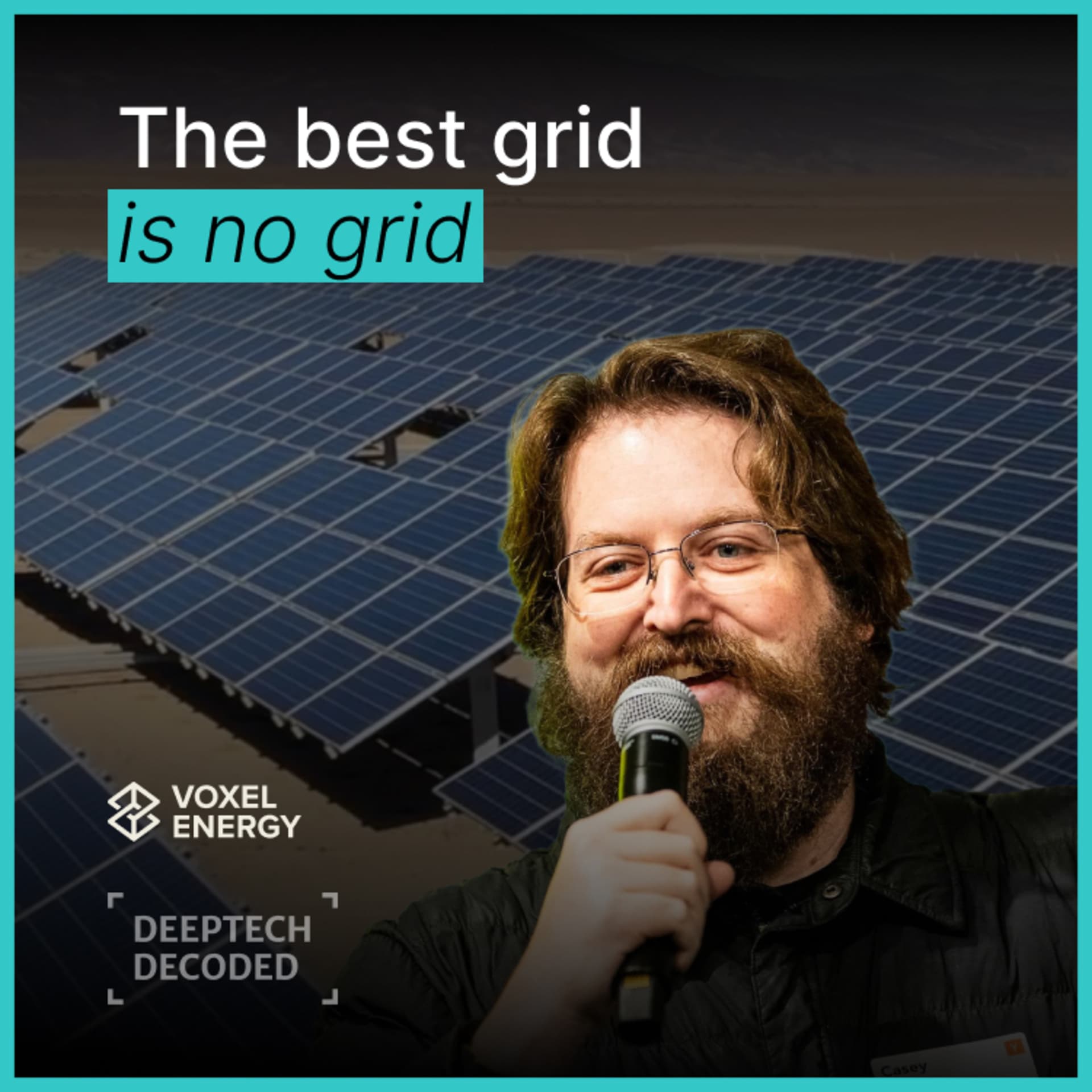
Yeah, I'm good at first principles engineering. Tesla's modus operandi is being scrappy, knowing when to question what it is you're doing and completely rethink a paradigm. If there is a problem that you're facing, question how you got there because it could be that you're focused on fixing this problem. Whereas the system that put you in front of the problem itself might need reworking such that you might not need to solve that problem to begin with. And that's what led to now Voxel. If the grid interconnection is the problem, then the best grid connection is no grid connection. And so that's the foundational principles and basically everything I do at this point.
Love you guys. Yeah, but also like it is, you still do something. Some of the folks out there are like looking like this, like, huh, is it a long-term solution? Is it a real solution? Is it something like he tries to take the opportunity in a way the window is open and then let's just leverage as much as we can. Perhaps, can you just give us a high level Moxil energy, like just to remind or. listeners, what are you guys trying to do? What are you trying to achieve? And then we break it down to the components and try to understand how you do it.
Mm-hmm. Mm-hmm. So as I just said, data centers, no grid connection. We deploy 10 megawatts in approximately 200 days. I'm pushing for 150 days. And if you're anyone else, national average for that size is like five years. There are $3 trillion worth of data centers slated for construction by 2030. Half won't be made because there just won't be the energy availability. A lot of people are going all in on things like diesel generators. Well, Now diesel generators have a multi-year wait list. Okay, now natural gas. Well, there's only so much natural gas. And so we're kind of running out of natural gas pipeline connections. And so what's available and what has the capacity to maintain production level are solar panels, wind, and the batteries we leverage. If you're anyone else and you're trying to get batteries in enough quantity to sustain build-ups this big, you're going to producers like cattle. CATL and they now also have like a two-year wait list for appreciable size energy installations and
I think even wind doesn't count anymore because they are all booked out till 2030, if I'm not mistaken. All the blades are all just booked out. And how many companies are building that on the earth? Like hands, handful, like four or three, if I'm not mistaken. I was so shocked when I heard about that. It's literally.
all the blades. There you go. Not many. Yeah. I know that the larger manufacturers of turbine blades, for whatever reason, are being really precious about their production numbers. I think the rationale is they don't want to increase production capacity or change their production methodology for fear of compromising the product. given the demand, it's an odd choice to not do that. But I'm not overly familiar.
with their thought process. All I know is it is very difficult to actually make the veins for the props in a turbine. And so that's what's really stifled the numbers for those. But as far as the batteries, there are tens of gigawatt hours available of salvage EV battery packs. And so the idea for us is we know how to leverage those Tesla batteries. My CTOs, prior business was in converting vans to electric using crashed Model 3s and Ys. So he literally pulls out the Tesla stuff, the motor, the battery, some other components, puts into the van, and have an electric van. And so he asked me a while ago, like a year or so ago at this point, he said to me, vans are cool, but I'm just turning cars into cars. There's a better use for this energy capacity that's out there. And so back in napkin math, you what's consuming a lot of energy? It's data centers. And So we ascertain that given the pipeline he already has and the technological advantage he already has, we don't repackage that battery pack. We literally leverage the technology that's already in the pack as far as the power conversion system, the battery management system. We can build that quicker than anybody else, cheaper than anybody else. And we have access to batteries that nobody else has access to. And so we could build a data center in days. Yeah, that's it.
Mm-hmm. So I met Max, the CTO in a Tesla hacking community. That's when Max started the van company. And then Evan, our COO, met Max through a mutual friend of theirs because that friend told the two of them that they are basically the same person that they should hang out. And so they did. And then Evan went on to work with Max on that van conversion company. And so we all kind of intermingled. through the conduit of that van conversion business that Mac started.
Okay. Well, Casey, I recently heard a conversation about one of the executives of Microsoft energy who spent his time all about data centers. I forgot the name. don't recall. And what is it? He seems your model, not the proper way of handling it. Like not a long-term thinking. And what is it that he's missing and you guys are covering?
He might be thinking specifically about battery production numbers, availability, maybe battery health, longevity. It could be a million things. Maybe he's thinking of the land it takes. Maybe he's thinking, if I want to build a 10 gigawatt data center, then I couldn't feasibly use solar. And technically speaking, physically, could you sure? Is it a good idea? Hmm, debatable. But if I want to build a 300 megawatt data center with solar and battery, you can. And in fact, Intersect Power, who builds those in California, was recently bought by Google for $4 billion. And that's exactly what they were doing. They were building hundreds of megawatt spec data centers built with solar and battery. They were using Tesla Megapacks, which is Tesla's solution for stationary industrial storage. But now Tesla...
has a multi-year wait list for those batteries. So all of these resources, no matter where you go, are somehow constrained. Truly what's available now is solar and these repurposed batteries. And that's like the key to our speed. So we could very feasibly build into the hundreds of megawatts, even gigawatt. There, it's feasible, but there we'd literally be getting into world record solar. installation sizes, but honestly, my philosophy is so what? Records are meant to be broken. If you tell me, that thing's really, really hard, really, really hard isn't impossible. And you do a few and that recontextualizes what it means. Like if you told me that 20 years ago, the South African dude would be launching and landing rockets every single day and making space accessible, no one would have believed you. But then once you do it,
Yeah, actually speaking of the constraints that are like multiple question marks like popping up on my head and one of them was the second life batteries because the, don't know, even if I know nothing about it, the very first thing comes to my mind. This is such a high mission critical business and how on earth am I going to rely on second life batteries? Like, do you know what I mean? Like the whole in the same sentence makes me think twice.
What is it that they try to do differently so that I have this access on my mind where you have off-grid and you have like grid and then you have also this very nice concept around the AC and DC. So this is like AC and then DC first. So you're at the ideal corner, right? At the top. So have off-grid and DC advantage, which comes with those batteries.
But it helped me understand even when I run GPUs in the very first two weeks, 10 to 15 % are like failing and the spikes are so extreme. And I, on top, have the second 10 batteries, like put them all together. Do you, I just ring in my head like maintenance, maintenance, Like how do you make sure that, you know, this is smooth and reliable so that you're not considered as a backup plan, you're considered as the first source.
Mm-hmm. So I can cite a bunch of statistics. Tesla battery packs are the most reliable and we use them, ergo we inherit the reliability. Even when Tesla was testing their own battery packs, you have to run a fire safety analysis which requires setting a battery pack on fire. Tesla could not set their own packs on fire. They had to drill into the battery and then hold a torch in the battery to get it to ignite such that it would go into thermal runaway that actually overtakes the fire resistant potting between cells. So from a very direct perspective, we inherit that safety. From a certifications perspective, it is a little bit different in that car batteries are certified in different ways than stationary batteries. And so we're going through that certification process of our own accord with our battery design. That's happening now, in fact. So we'll get those certifications so they'll meet the same standards as anyone else does. So then it comes down to a matter of perception. And that's fair. We do call them, they are technically repurposed batteries. But the way we purchase them is we have our own tools to inspect one, that's in good physical condition, and two, we can leverage the batteries own self-analysis tools to tell us what its state of health is. So if it's at a good state of health, then we want it, we buy it. If it's not, we don't. It's as simple as that. So we're already getting certifications. There's already a factor above that of Tesla certifications on the batteries. And we have our own tools for ascertaining state of health and current condition. So these are the best batteries in the world, both in terms of packaging, weather tolerance, thermal management, chemistry, rigidity, performance. And from a data center operations perspective, there's such a thing as like these massive spikes.
an energy drain. If I'm working at a more traditional data center that's connected to the grid and I anticipate there's about to be a massive training spike, I literally have to call the utility and say, we're about to hit a massive load. I need you guys to give us as much power as you can, almost like we're in the Titanic and you're calling down to the engine room. We need more power.
And if they, yeah, and if they don't respond in time, maybe the whole thing shuts off. Maybe you brown out the local municipality. Whereas because the whole thing, the power goes, the power is routed through the battery in all cases. And so we are the way we architect it. It's like N to the multi thousandth power redundant, depending on the size of the data center and the battery inherently. can handle that massive drain. Because these are literally car batteries. They're meant to withstand massive acceleration in an instant. So they have something like a 10-C discharge rate. They can discharge at 10 times the rated capacity. So if there's a massive spike, there doesn't need to be any kind of manual intervention or control. The batteries just accommodate for that energy demand, just inherent to the chemistry.
It reminded me of the recent, or not recent, but the incidents that Meta has at their data centers and then they placed power plant, no blow up operator. was like, whoo, like it's a real story. The spies cause a massive damage and then now they have additional resources to prevent that. And therefore I had this all triggering question in my head, how about on earth and the second
Mm-hmm the whole thing Yep, DC microgrid since we control the entire stack like we're a vertically integrated power solution Everything is DC DC from the solar DC through the battery DC into the GPU it all operates on DC People architect with AC basically just because it's what status quo people control different components And so they design their components in such a way that it adheres to an expected standard
But if I'm controlling that entire vertical, I can control that standard and make it DC. Again, it's the Tesla way of going about things. When they made the Cybertruck, they made it a 48 volt architecture because that allows for higher power draw and allows for higher power components and thinner wires like the order effect of positives are numerous and
The reason why everyone's done 12 volt is just because everyone's done 12 volt. 12 volts, 12 volt because 12 volts, 12 volt. Yeah, that's just how it is. And Tesla said, we need 48 volt. It's more efficient, makes the car lighter, easier to manufacture. It's how we're going to do steer by wire because we need more power for the motor on the rack. So hey everybody, they literally made a document, a entire prospectus basically for how to build
48 volt architecture and then circulated it to all the other auto manufacturers like hey guys, this is the future this is how you build it and We're we I like to think we're basically doing the same That we're controlling the whole thing because from a first principles perspective. That's what makes most sense and So we see because we've already built this we see that it is 26 % more efficient So if you're operating a hundred megawatt data center you are either saving 26 megawatts worth of energy or you are able to deploy more GPUs on that microgrid. So it is the way things should be. It is the way that we are building.
But also that this could tie back to you said, I don't know how to solve it now, but I know when the time comes, we're going to tackle that too, because right now we're talking about megawatts. And if we see, look at the feature and then especially take XAI as an example, one to two gigawatts, like a massive difference. And then the industry is not getting any smaller or less ambitious day by day. And they're going in that direction. And that's probably Then you just want to tackle one step at a time. that be the right way of looking at it? Because right now you know that your time to power is your strength and that you can give within weeks, like within months. And how do you see yourself reaching there?
So everyone's saying, want gigawatts, we're planning on gigawatts. Well, you know what? I'm going to announce it here. We are also planning on building 100 gigawatts. That's right, you heard it here first. What I won't tell you, and everybody stop listening, that 100 gigawatts is over the course of the next thousand years. But that's not important, don't worry about that. ⁓ And so that's what's happening. Everyone wants a gigawatt.
Everyone says we're building gigawatts. No one considers the time scale. No one considers the feasibility. And so it's a good sound bite. But from a business perspective, it's an indicator of where things are going. But in such a long tail that any number of things could happen. There's a solar breakthrough that quadruples the output per panel. There's a battery breakthrough that quadruples the energy density.
Everyone is building in space because somebody figured out the thermal management. Could be a billion things. And so what we're focusing on is what we can build now, the demand we can fulfill now. And is it feasible to build a gigawatt with solar and battery? Yes. I will tell you from a business perspective and, frankly, straight honesty's perspective, from a cost efficiency perspective, it's more doable with a combination of solar, on-site fuel of some kind, whether it's natural gas or diesel, and battery, and you can still just queue for the grid. What we're going to do when we build these, solar, battery, depending on the customer wants, some level of fuel to account for like the 0.3 % that, again, cost efficiency, but we also queue for the grid. So we just wait for the five years and we operate in those five years.
And then once it's connected, 80 plus percent of the time, we sell energy back to the grid. We become a grid asset, not a liability. And in that 0.3 % of the time when the solar and battery needs some shoring up from another source, grid. And so instead of consuming hundreds of megawatts to gigawatts a year, if you're talking about like time scales,
Just to make things more concrete, let's take an example. Can you give me an example of one of your prototypes? Because it's live and it's working. What is the scale you're talking about? What sort of data centers initially are aiming for? And of course, I can imagine you would like to collaborate with hyperscalers. And also hyperscalers have this kind of-
little bit more hybrid approach to not like everything needs to be from the guest energy power plant, or they also try to do like, think the term is like behind the meter or is it the right term to say? Yeah. So like, let's take a look at, from the moment that you identify your customer that you built together, your early customer, what scale are we talking about? Because in Singapore, I've seen a building of a data center. was like, how is a five stories building as like, is it a data center? And also I have seen data centers that like massive giant. And how do we also find places to make the solar available? And my last question, like around this, just I tried to depict it in my head. And also the other one is how geography, how important is that? Like, would that work in Syriam versus Texas? I think you got me. Like what's your ideal scenario and then you expand from there and how do you build it?
Mm-hmm. Mm-hmm. So in terms of scale, what we've built is on the order of hundreds of kilowatts. We are working with people into the megawatts and we have and we're working with a I'm trying to figure out what there are NDAs in place. I'm trying to figure out what I and can't We are working with a Neo cloud. on a very large build out. This would be a 60 megawatt build out, which considering it would be solar and battery would require about 1500 acres, which sounds like a lot because we have a general idea of what an acre is and then I say 1500 acres, my God, that's so huge. Your land must be so expensive. We previously got 600 acres under contract for a prior project. Guess how much it costs to get that 600 acres under contract.
I guess you are. No, that speaks to your capability. Like you're definitely the closest, you're the first to come under. But yeah, 10,000 for 600 acres, 10,000 to get under contract. So 1500 acres, no big deal in terms of scale, in terms of that process. And so that will be a 60 megawatt project and target deliveries by the end of next year. So the first 10 megawatts would be deployed this year.
So literally from the paperwork to power to what is kind of like literally within months. you build on it. It's not like wait for the big bank installation. No, no, no. Like we gradually get bigger. Nice. I must, I would love to see the eyes of the customers that they must be thrilled to have someone like this and coming and fixing my biggest headache.
Is that how is the conversations when you reach out to the folks? Are they looking first? because it's the hardest part is always the first, right? The very first guy who believes in you and then who says, let's build this together. I am all in with you. And also you want to do this with someone who believes in you, not only transactionally. Okay. If I pay you this, can you provide this? Because they're excited so that they can give you a constructive feedback, your loops or starts. to be evolving. How did you guys manage to do the reach out like a, you know, the bull's eye dream customer.
Mm-hmm. Mm-hmm. Mm-hmm. So this business operates entirely on warm introductions. The SaaS model of outbound and online presence and whatnot, practically invalid for this. Some level of online presence is not a bad thing, but what actually closes sales is getting a warm introduction, having conversation with the person, basically
having a sort of social proof in that warm introduction. Cold outbound does not work. Finding the right person is difficult. And so by leveraging my network, I was able to find someone. Conventions are huge for this because conventions themselves aggregate everyone and condense everyone in the right people or in the right place. GTC is a huge one. There are multiple data center conferences as well. There's a big one happening in New York at the end of the month. I will unfortunately be doing demo day because that's when the YC batch ends. And so I'm trying to figure out, know, like how, can I send someone in my stead? but yeah, sales is all about getting in front of someone in this business because it's a relatively tight community. and so
Bye! I think also the product offer is literally, you know, entangled from the 2024 batch that they provide a software to the data centers. Like in their case, cold recharts work. Like they did so many creative ways of getting the attention of folks because as much as like they try to help them to run like as I've said, uptime, maximize uptime. But I think there's still a way to back that up. Like you can gradually phase into that. But with you, like I have to trust you're going to deliver this. I don't think that there is anything in between and too much of commitment financially. And at the same time, operationally infrastructure wise, that's died. think you're, you're very rewarding, but also your risk is way higher too. Right. That's why you need these warm introductions. And then.
Yep. Yeah, we're not SaaS. Like, it's very cumbersome to work with us. We can't just like, hey, let's have a demo. And then you have a demo over a Zoom call or whatever. that's, know, cold outreach works for that. But it does not work for us because the real stakeholders are higher in an organization, whereas people below the stakeholders, like even VPs, are trained to be risk averse.
because if they consider something to be a bit too risky, it could jeopardize their job. can make them look bad. And so they swap something away if they don't consider it safe enough. And so my job has been to find the person above them and convince the VPs because obviously I have to maximize my surface area for converting sales. But yeah, I wish we could just do cold outbound like demo over call or something. it's infrastructure, it's energy. It's too heavy.
Yeah, I think also like once Elon Musk tweeted saying on PowerPoint, everything is possible. I can't promise you everything on PowerPoint on the Zoom call. But like, how is the proof? The proof part, what was your very first proof, evidence to earn the trust? I guess it's just the personality in that moment and your references, what you built so far. And then they just build the trust and go with it.
Mm-hmm. Yep. Yep, you got it. has been, yeah. Team composition has been huge for this. Given our Tesla pedigree, given Evan's pedigree and actually building these things, we have built smaller versions of this, like I said, in the order of hundreds of kilowatts that like operates end to end. Like the architecture is the same. It's just a matter of scale. Solar, Tesla batteries, compute, DC, round trip. But it has been team.
Yeah, your team cohesion is really strong. ⁓ I so much enjoy the conversation, but then I recognized also like we are already a little bit half-baked through more than half-baked. I'm going to just invite Cameron to bring us the questions from the audience we have. Cameron, am I doing well with timing?
I think so. I think so. I think we were running for an hour and a quarter was like the ideal total time, right? I think, yeah. And the conversation to me is like, it's been really interesting to listen to. So I've sat there with a big smile on my face while someone listening and that's always a good thing. Not that I haven't done that through any of these, of But the good thing is we've also had quite a little bit of... back and forth within the questions in the chat as well. Some of them I am going to read relatively verbatim because they get a bit technical. ⁓ So I think what I'll do is I'll go to Robert who's had or we'll start actually with Sanjay and some of more recent questions. So he's basically said,
Mm-hmm. Before we get started with that real quick, I'm just going to say I have not looked at the chat. I don't know what the questions are. I think I know a question someone is going to ask me eventually. I'm surprised it hasn't been asked yet. And I'm just going to put that out there. And when that gets asked, I'm going to call back to this moment. All right, so go ahead. Sorry for interrupting you.
That's all. Right. Okay. So on the first one, um, search from Sunday, he's basically said, love the ethos, love the ethos, um, lithium iron versus iron air, understand the efficiency loss on iron air, but long duration energy storage could be interesting and lower supply chain risk. And then he said, are you anticipating a secondary grid connection? If so, are you planning to also provide grid balancing services? How do you plan for changing regulation, et cetera? I know that kind of touches on some of what you were speaking about in terms of the evolution of what you might look like as you kind of queued bit prepared to be able to connect to the grid and that kind of, I think it was five or so year timeline.
Yeah, so iron-air. Long-term battery storage is an interesting concept to us as they already noted that energy density isn't as good. But we were looking into ways of having like a secondary battery system for long-term storage because that could make sense. Because given our model, we overproduce with solar most of the time. And so what do we do with that excess energy? Until we have that grid connection, we're trying to figure out what to do.
And so it could be we have a secondary battery system that's iron air that in the future, during the 0.3 % interruption time where like weather is out of our anticipated bounds for interfering with solar production, and we would otherwise have to kick over like diesel and that gas, maybe we kick over to the iron air that we have instead that was previously charged with solar from days or months before.
⁓ We were looking into generating, not generating, but producing and storing hydrogen on site. Literally doing... a sort of reverse geothermal process where we store hydrogen in the soil that's been produced via excess power from solar and then draw on that hydrogen when needed. That got really complicated, really quick and required very specific conditions that made it prohibitive. ⁓ In theory, if we happen to come across like the right
plot of land that has the right shoal to accommodate that and the right geographical characteristics, it could be great, but vast majority is not even worth considering at the moment. So iron air, interesting concept for like long-term subsidy of our primary battery. And then yeah, we talked about like connecting to the grid and backing up that power, which I would love to do. I think that our long-term plan is to near term
So I'm going to go to a question from Adam. It speaks a little bit to part of the end of the conversation you were having with Nahal around kind of finding those first customers. I know you mentioned that it's a very warm introduction, heavy, relationships you've built over time. And that's, that's come honestly through the hackathons and then it's kind of built through your kind of experience at Tesla and elsewhere. The immediate question is before you had a product, was it difficult to get large data centers to take you seriously as a startup? How did you overcome some of those challenges and how did you convince them you could scale?
So funny enough, the large Neo cloud that I was introduced to, that conversation started before our prototype was even done. And so that really does speak to one, the importance of having a good network and making those introductions and two, team credibility. Because the person I knew that knew this person in the Neo cloud, would not have introduced me if they didn't have confidence in me and they didn't know me and they didn't know my ability. And so that is like a fine, it's a difficult dance in like deep tech and hardware where you need the money to make the thing and you need the customers to get the money, but you need the thing to get the customers. And so it's this chasm you have to cross, know, like the tried and true
So obviously two primary use cases, training and inference. The larger ones, training, don't need to be that geographically sensitive. Inference, ideally, closer to a customer. However, we've been speaking to some generative AI companies that are looking into getting their own GPUs, because thus far they've been leveraging Neo clouds, but for cost optimization purposes, they want to start buying their own GPUs and co-locating them themselves. And so that would be more like an inference load.
Yet, they have also said they're not particularly sensitive to geography. And actually, those loads align with our power generation profile quite well. They said that the vast majority of their usage is during the day, during the night, practically nothing. And so that's great for us. And that means that we feasibly could actually build a data center for them. That is just solar and battery, because that fits our profile fantastically.
Yeah. Mm. Mm. Okay, beautiful. And then I think we kind of talked about this, or I said we, Nihala and yourself talked about earlier on some of the incredible efficiencies you get in terms of the discharge rate. you know, it's kind of, I think, built very well for a lot of the existing use cases out there, even if it wasn't the specific reason the battery existed. Moving on from that, Robert's got some more, I guess, in-depth questions, so I'm going to do my best not to butcher it.
So sliding scale, it depends on a lot. It depends on the specific PV. It depends on the land. It depends on the power drop profile. The biggest contributing factor is locations, the geography. Could you build a data center in like Maine or Michigan or anywhere in the north powered by solar? Technically could you? Sure. But it would be I don't need like two, three X's big at least because obviously solar radiance is so much lower. ⁓ And so then that contributes to factors including like the actual power draw from the data center itself, cost optimization, blah, blah. So when we go from the cell to the battery to the actual data center, that is a good question as far as like what the actual
energy loss is I'm confident in saying I do know it's 96%. It's 96 % efficient. Whereas your typical AC infrastructure where it goes DC, AC, DC, AC, DC, AC, I think there's something like five different transformation points. that is more like 70 % efficiency. Yeah, 70 % efficient. And that's where the 26 % comes from because we still have some loss in the form of 4%. That's why we're not at a dead 100, whereas AC is at 70. So the delta being 26%, that's our efficiency gain.
So for us, we're mostly building in the Southwest, like I said, New Mexico, Intersect Power, who I mentioned earlier, they build in California, which is an interesting choice. I can see why it's a proximity thing. California, even though it's renewable, even though it's solar and battery, California is really difficult to build in just generally. Any kind of permitting, California is very difficult. So it's an interesting choice. And frankly, I suspect ⁓
very primary driver in why Google bought them because they have pre approvals for these massive multi gigawatt build outs for solar in California. And so the permitting alone gives them like a multi year head start on anyone else that's building California specifically, New Mexico, other States, completely different story, Texas, practically a free for all. And so in that 1500 acre site, I talked about with 60 megawatts, vast majority is a solar panels.
Mm-hmm. Okay, that makes sense. And then I think another kind of question that came from, whilst you were answering that was potentially Robert seeking a clarification, which is so if you had to put it in terms of megawatts, how much is the data center? How much is the PV and how much is the energy storage system?
Don't want to get you in trouble, so yeah. Okay. Robert, we're going to leave it at that and you can figure out the rest. And then I think also just a kind of comment from a few people as well, just that they're really bullish on, you know, some of the architectures that we're talking about. And I know, I think there are some, you know, similar competitors, and there have been some comments about that. But I think I'll avoid that for the context of kind of getting into the nitty gritties of, you know, between this company and that and, know, where there may be sensitivities around what everyone's doing as well. I think from my perspective, it's just been really interesting to understand your journey and see how it maybe wasn't conventional in terms of the the May school versus kind of a traditional college route. Someone who went into education like a little bit later did a gap year that turned into 10 years of work and then went back and did some more education. Kind of makes me feel a little bit better about you know some of my choices which is nice but I think it's a good reminder that
to know everyone's built from the same cloth. it seems like you really were able to find your people along the way. And honestly, the brain control of the drone thing blew my mind. ⁓ That was just such a cool story. If you can do that for the beard man, mean, you know, then it will just be like one of those things you keep on seeing on a like TikTok where you put your head in the weird thing and get a haircut, I completely don't trust.
Yeah, yeah, yeah. I saw a video recently of like a peachy dish containing a bunch of human neurons controlling doom. ⁓ And that's very much literal mind control of a thing. ⁓ Yeah. So the next couple of decades are going to be real interesting between AI and where we're going with neural interfaces. ⁓
Kind of a part of the motivation in what I'm doing. I'm not a great software dev. I was a software dev for like three months. That's how got into Tesla actually. I entered as a software engineering intern. But hardware has always been my thing. I need to physically interact with the thing. And we're experiencing now that for myriad of reasons, we're going back to basics. We're going back to hardware. Deep tech is having its moment. Space tech is having its moment. Energy is having its moment.
And so I feel like this is an opportunity for me to really work on the foundation of what will contribute to all these paradigm shifting technologies. And what I love about having worked in Tesla is whenever I see any given Model 3, there is a non-zero chance that something I did contributed to the production of that car. And there's a non-zero chance that code I wrote is currently running in that. And so then that says to me, all of these cars were somehow contributed to me. If it could be any of them, it is all of them. And so that's the way I look at this opportunity with energy. There is a chance that any given AI could have been trained in one of my data centers. And so then to me, all of them feasibly have been trained in one of my data centers. And so I feel like I will be contributing to these paradigms in that
Yeah. Absolutely. There's just this image popped into my head of you just standing in a room, of like someone about to lead an orchestra. It's a little bit evil villain, so hopefully, you know, we don't go fully that route, but it's a nice way to think about it. And I think I like the reframing of the impact. Must be an exceptionally cool thing to just be able to see a Tesla drive past and know the contribution that you made to that. Yeah, extremely validating, I would imagine.
Yeah, absolutely. flexible data centers versus off-grid data centers. So I'll see if I can go up and find the greater detail on that. So it was the question of, I guess, what do you think about the kind of bring your own power versus off grid move? There are other people out there who are potentially developing the first demand side flexible data centers. How would you see yourselves, I guess, taking on? Or do you believe in the fully flexible data center? Or are you full on off grid? And then why so?
Well, like I said, we're off grid as is makes sense. It still makes sense to just queue for the grid, connect to the grid, and then contribute to the grid. The flexible data center concept is interesting. We intended to be like the entire data center stack, including the shells out of the gate. And then we had conversations and decided that might be a bit too much for us to bite off. So we'll focus on the energy infrastructure first, then revisit.
the actual data hall, worm shell, power shell, however you want to phrase it. So the flexible data center, like I said, is interesting. And I think modular architecture certainly is the future because data centers as a paradigm harkens back to telcos basically, like AT &T. ⁓ They were the architect of the data center paradigm decades ago. And data centers really haven't received much technological attention since because they just haven't had to.
And now practically overnight, the entire world is trying to revolutionize these things. And so that contributes to a lot of what's happening, why there isn't enough supply for the demand, why it's taking so long to spin up that supply, why it's still hard to have these conversations, because there's still a lot of legacy factors and legacy stakeholders ⁓ that for, you know, everyone is acting in the best of intention.
But it's hard to revitalize such a legacy industry overnight, even given all the money involved. But given what we are now facing, the rapid development of the technology, the GPU architecture, there will be modular architecture. There will be flexible architecture because as the silicon architecture changes, so will the data center have to change.
there are billions and billions of dollars worth of data centers that are being demolished because they physically can't accommodate liquid cooling and liquid cooling is where the future is. Like that's where everyone is going. It is inevitable. ⁓ And so what that means, it's a proof point right there that you've had to destroy this massive amount of architecture and incur all this cost because you weren't prepared for swapping in this new technology.
And so why would you build something now only to enlist in that same outdated paradigm? And so you need to make something modular that because right now it's liquid cooling and then further on the horizon, maybe it's immersion. I was having a conversation with people last night about immersion. And while it has some aspects that are compelling, not quite yet. Eventually, probably, possibly, maybe, but definitely not now. But then beyond immersion, who knows? Maybe everything will be liquid nitrogen.
And maybe we'll need like insulated liquid nitrogen ⁓ transmission. And yeah, yeah. So things need to be modular and flexible. So I do agree with that. And I do also remember somebody's question earlier about policy they'll touch on real briefly. ⁓ There is still a policy in favor of dangerous urban construction. There's weird stuff going on with the current administration when it comes to renewables. But if we package it in a
data center form factor, then everybody loves it. And so strictly between this call and us, don't tell anybody. If we can very discreetly solar pill and renewable pill America by packaging that medicine in the peanut butter of data center construction, then I am all for it. ⁓
That's it. Perfect. Awesome. I think that's a really nice point to kind of step back and bring Neha back into the room. She always will have a few questions at the end, I think triggered by what we've spoken about. So I'll let her kind of run through those again and just everyone in the chat, if there wasn't a question that was answered or there's more that comes up, we'll take those offline and we can have the kind of conversation with Casey afterwards and kind of put those in front of him when he has time to be able to kind of...
Converse again. So thank you. It's been an absolute pleasure, Casey. I'll hand it back to Niraal and yeah, thanks so much.
If a technology increases, gets more efficient and actually demand for the resource, demand for the usage just increases, which brings me to the point. AI and the pace and everything we are going, I don't think it's going to slow down ever unless governments just say no. And then I don't know, like all the non-realistic things happen. And if we, we are all working towards super intelligence, right? And if you break it down. that are like almost four or five components of the entire system of superintelligence to reach from chips to algorithms data. And the most critical piece is not even anymore chips to power. That's where you come in. It's fossil energy, but they're also data centers being built in space. I right? So, in that very big picture, I don't see you guys like literally head to head competitors. But I let you explain how you see it and where you see the learnings from each one another. But at the same time, it's still a technology in the face to be very literal. And we also have Philip Johnson from StarCraft. I wish I could bring you both together. That would be an amazing conversation. Was that the right piece in the puzzle that we wanted to cover?
Mm-hmm. Mm-hmm. Yeah, yeah, you got it. ⁓ Practically every single day, and I'm surprised it took this long to come up, is data centers in space. But before I get to that, yeah, as far as like the demand for it, it's definitely not going down. It will never reverse. It will never go negative. There will never be an empty data center from now until infinity. Demand may wane. Construction speed may wane.
But it might be the same paradox we're talking about, but like the paradox is basically, if there's open space, we fill it. The reason why we don't just build a bunch of lanes in a freeway is because that doesn't solve traffic. That just means there's more people on the freeway. The actual rate of traffic speed doesn't change. And so that's why I honestly don't really worry too much about competition because there's enough demand to go around and frankly, there always will be.
Um, and so then going to, uh, data centers in space, um, Phillips, really cool guy, uh, spoke to him briefly. He's really accessible. He's like really helpful. All these also went through YC. Yep. I'm really curious as to the thermal management, um, because, and he's spoken about this. You two spoke about this a bit.
You can't use convection cooling in space. Like there's no medium to take heat from here and move it over here. Because on earth that's done with air. Ultimately that's done with air. In liquid cooling, the loop goes through a radiator that has copper fins and the fins are exposed to air movement. The air wicks away the heat from the surface of the radiator. You cannot do that in space. So you have to radiate. And so can you radiate heat in space? Yes. But... The surface area is immense. And so for a while I dismissed entirely, like I'll be honest, I dismissed entirely because I thought that's ridiculous. Like the amount of resources, the engineering for that is ridiculous. It won't happen. And then in conversations I've had with people for my thing, people say to me, aren't you going to need a ton of land? And I said, yeah, so what? And they're like, that's ridiculous. That's a huge amount of land. It'll never happen. And I said, that's... It just needs land, so what? Hmm. I, that's, hmm. Okay. So just because it's ridiculous doesn't mean it's impossible. there are differences. You know, we all, we'll have our same challenges. Like for us, the huge land means a lot of transmission cable for the solar. for him. The huge radiators means a lot of coolant, pump relays, exposure to like space debris. And I know that he answered he's far enough away that like there really won't be much if any space debris. but the surface area for the radiator, I do wonder if that would even be bigger than the solar panels themselves. And then my concern becomes if you're trying to radiate away heat, but your radiant surface area is exposed to your source of heat, i.e. the sun that you're using to power the operation. You don't, if it's 20 megawatts in, it's not 20 megawatts out anymore, it's 20 megawatts in plus the heat you're trying to radiate out and so it compounds. And so I'm wondering what his thoughts are on that. And again, like the radiator size, Honestly, the solar panel size, not that big a concern for me. There's someone in my YC batch that's making like mechanical structures for like reinforcing the rigidity for those solar panels. And so there may, maybe they'll collaborate, you I don't want to speak to their business too much, but it's the radiators, it's the thermal management that has me most curious.
Mm. Have you ever heard about this super ambitious project where they try to shrink down to shoebox for the data centers? Like that's the very extreme ultimate. I should have a little bit dig into that. But as you say, I think even sky is not the limit anymore. Like you just need to think through and then take the first possible piece of the puzzle and then the rest is going to continue because This is not going to stop as you just said, and there will be people like the StarClaw team, like Foxil Energy, that these people know their craft. Let me put it this way, because their IP is very valuable and what you have in your hand is also very valuable. It's not just a commodity that tomorrow the hyperscaler is going to kind of say, yeah, I can do this too. Let me grab my team, build it up. And then we are going to also. start doing it. Thank you, Casey. We don't need this. already covered this. I don't think that, so this is more like the direction we are heading at. then anything you have specialty, leverage that. And honestly, the problems that you guys are tackling is more exciting. I know the tech is difficult. know, but isn't it the best because it has such an indirect effect in our lives. Like from grandma to the newborn child, like it is actually the biggest leverage than a SaaS. I'm not underestimating. I developed SaaS tools, the SaaS softwares too, but like this great, makes life better, nicer, more efficient, say. But then this, that the power, I don't know. find it like fascinating to watch what you guys are both building.
Yeah, and like I said, I agree. Like we are feasibly a touch point for practically everything. And so it makes me feel connected to everything. It's very difficult. Like I said, totally different game than software. And we're the people that generally you don't hear about. ⁓ there's someone in my batch right now called Octopulse. They are dramatically influencing fish farming. they're making it radically more effective, radically better. and when they first presented to our batch, said to my co-front, we all said to each other, in fact, that's going to be one of those companies that's going to revolutionize a crucial, I think it's technically agriculture industry that no one will ever hear of.
but it will quietly influence the lives of thousands to probably millions. And so you have to be in love with the space and really love what you're doing to do this kind of thing because it can often be thankless, really know visibility, but the community is tight, the community is passionate. And so it's a lot of fun.
Mmm. Mm. Yeah, but I think I don't think that you can pay someone to do this. You know, we pay on top of this, but this needs another level of commitment and enthusiasm. among all the good things and the sunny pet scenarios, like what is one thing that keeps you up at night? Like, is there anything that feels like, guys, like we had a U-turn, now we are over or, ⁓ I almost solved the end, but then we figured things out.
perspective on failure. Because if you fixate on failure, cannot, you can't work in a startup, any kind of startup. You can't be a founder if you fixate on failure. And so you have to have this innate self-belief that whatever happens, oh, then I'll fix it. And it's that simple. And of course, as things approach, then you need to increase the complexity with which you approach this problem. But
Casey, human beings are very interesting. Like, we do believe in things, sometimes they are contradictory with each other. And at the toughest times, it's what you believe. It's not what is rational. It's not what your dad told you to, like a mantra. Like, do you have any sort of this belief you hold true, but they contradict with each other?
Mm-hmm. Mm-hmm. you know, it's funny you said the dad thing is my dad always described me as consistently inconsistent. and, that's, that's kind of like the nature of, of being like one day you're doing one thing, the next day you're doing something different because you have to be able to adapt. you have to stick to a core thesis, a very core thesis, but how you get to that core thesis has to have some level of malleability. on a level of abstraction. So the core thesis for us is energy independent compute. What is the first principles approach of doing that? It's what we're doing. It's the solar and these repurposed batteries, DC microgrid. Okay, well, how do we do that? Okay, well, that comes down to one of our first customers. And now we're getting a little flexible. Well, what is our ICP? Who should we work with first? What exact companies, how do I approach them? So the further away you get from your core, the more flexible you have to be because the more flexible society becomes basically, the less objective it becomes. And at end of day, we live in a society. nobody does anything in a vacuum. That's another thing I really try to stick to. Nobody has anything in a vacuum. Nobody has ever learned anything in a vacuum. I don't care who you are.
The only way to have ever accomplished anything is if like you spontaneously spawned in the middle of like the Mojave Desert and then taught yourself like bubble sort. Congratulations. You like naturally taught yourself bubble sort. came to that on your own, but to do anything significant, like we stand on the shoulders of giants every day. So.
my god, it's such a delightful conversation. I'm so much enjoying it. I will definitely knock on your door once you guys have a little bit more progress with your start-off and with your product. There's one thing, it is really not relevant to deep tech, but I'm dying to ask this question. What is your favorite cartoon character?
Alright, man, we could talk about this for a little bit. What always comes back to me, I mean, if anybody in the chat, you know, I might be aging myself here, but like Ed, Edd Eddie, I love Ed, Edd and Eddie. I don't know if that was like so much of the thing in like Europe. I don't know. That's like an early 2000s cartoon. You have to Google it. Oh man. Ed, Edd and Eddie.
⁓ I see myself in all three of them, like Eddie specifically. You have to know the cartoon, but Eddie kind of resonated with me, honestly. And even the way we started this conversation, the miscellaneous things I did in school, anybody that knows these characters, when I say Eddie resonates with me, they get it, they know. If literally anybody in this chat or will ever watch this video knows that, they'll get it. What answers do you typically hear? Because that's an interesting question for like this venue.
No. First time ever I got so curious. like, am in a deep tech conversation. on a randomly, I'm going to just ask him his carton. But that's the thing. I don't have to grip. I don't have to grip. So I just go into the conversation and then it's like a jackpot. listening in. Let's say, so what we're going to do, we have a little tradition and I'm going to invite Cameron.
what happens is our previous guests, right? Cameron always leaves a question for the next person. And before you, we happen to talk to Elias and Elias is from YC summer 2024 batch and he has a question for you. So let me read it because there's some, I don't memorize. So Elias is saying.
What I think the future will look like in 10 years is a future in which people keep asking what I think the future looks like in 10 years. And what I hope the future in 10 years looks like is a future in which people stop asking me what I think the future will look like in 10 years. No, but I'm completely kidding. I stopped asking those kind of questions. And like, I'm really not trying to talk to I'm genuinely not because like it's like I know that it like speaks to my perception of the world. I do get it. But things just change so rapidly that anyone claiming they know the future is full of it. Especially now more than ever. Things change week by week. And so maybe we get some like very strong overarching lines like Jim Morrison of The Doors predicted electronic music and EDM in the 60s because he just went all the way down to what is like the base level of music and where is like culture going and he called the shot 40, 50 years in advance. Well, you know, maybe 20 if you count 80s electronic. And so where do I see things going? Space is interesting from a deep tech and science perspective. is really interesting. My very pragmatic perspective is we have enough stuff going on here that we should fix before we start going to Mars. Because as we discussed earlier, ⁓ building more lanes does not solve traffic. If we go to Mars, now we have Earth problems and Mars problems.
⁓ that doesn't, that doesn't solve anything. If we don't fix the root cause of the issue, which is us, then wherever we go, we will bring the issues. We will cause issues. and so spreading humanity across the stars is more akin to a virus from like a universe perspective, honestly. but space is interesting. and so I do predict more space stuff will be happening.
Yeah. But I think I'm always thinking smaller things like are we done on earth? But also like sometimes it enables you to fix the problems you wouldn't otherwise happen there to even handle. find that like therefore like if someone for example and you were a kid you were watching Ed Ed and Eddie right and then nobody could turn off the television because you wanted that cartoon you wouldn't
go for another cartoon. I think I sometimes see the same enthusiasm in the founders from space. Like for example, Skylar, we talked to Skylar Chan building hotels, building a moon hotel. And then I was thinking, there's nothing else he can think of. There's nothing else that he can motivate himself to go towards. like totally agree with you, but at the same time,
Yeah, and no, again, like, what's happening with space is important. It's good. NASA was important. It's talking point as far as like government budgets, why are we putting money into NASA? NASA was important because there was so many knock on technologies from NASA's development. And so it's the same concept here. Things that get poured into a very specific focal point when it goes in when it comes to space, then has this trickle down technological effect. when it comes to things that are more immediately applicable. And so that is important. I'm a big fan of that. It's just for me, I go straight to what is the end result? Let's say tomorrow, space exploration is a thing. I can go to a spaceport. I go wherever I want. How does that fundamentally change the human condition? I don't know that it does because we as humans will not have changed.
And so, and that is a very admittedly heady thing. Even what I'm doing, there's a case to be made that does it change the human condition? Arguably not. It changes how we interact with technology. It changes technological capabilities. There's a case to be made that like if AI truly does become like artificial intelligence, a super intelligence that It completely changes the way the society operates in as much as our responsibilities when it comes to paying bills, capitalism, capitalistic system. And what does that mean? Does that mean that now we live in this utopia where we can do whatever we want? Like that would change the human condition. Is that what's going to happen? No. Because that's not what happened. The technology we currently have was supposed to free up time and in that spare time, we have more time to do things we want.
The only difference is that right now the pace is so incredible. We achieved things that took us decades to figure out. And then if you miss like a six months, three months of model developments, boom, yeah, all of a sudden behind the curve. That's, that is the thing that is adoption. think adoption is going to be the key problem and meaning because things are going to get easier. Like see, a product is not an issue. One person can just build in almost zero cost. But now what are you going to build is the issue, like the thinking and then like really having the taste and taste is overused. in a way, if you have, if you didn't have the hands-on experience on the Ascend line, I would be curious to watch you now, like, because this is where the hot pot is. Like you, can really get burned very easy. I also worked in production and like production engineering. So this is the heart of the thing. You need to figure this out real time. Like I don't have a chance to say, write a ticket, come back tomorrow. No, the line stops. yeah, probably. But then I suggest that the AI containment, Mustafa Suleyman, he wrote an amazing coming wave book. I think he has a couple of good points in that. If you find the time and pick.
Mm-hmm. Mm-hmm. Yeah, I think AI is certainly like a new tool for creativity. Like I do think that'll change. Like, because even recently I was thinking I have this other thing I want to build and it occurred to me that with AI coding tools, I could just build that now. And it's not like, because, you know, years past, I'd have to do a lot of research and like, I do architectures and how to start. and how to make sure that there's proper code security and blah blah blah, like set up an environment, all these things. And to an extent, you still have to that to a degree. But if I wanted to just start playing with it and just see what happens, I can just do that. I can just jump in and make like a real quick prototype, no problem, plain language. And so that is definitely what excites me about AI. So as far as like humanity's future, where are we going to be in 10 years? I hope we have like a creative renaissance. Space is going to be infinitely more accessible because it's already infinitely more accessible than it was 10 years ago.
Well, mean, 10 years people, yes, still probably, but like Starship, Starship is going to be yet another like order of magnitude shift in like space accessibility and like launch cost. But then of course, you know, becomes safety and like, you know, it's actually still really hard to have life support in space. So all kinds of things happening, you know, still, yeah, fairly small people go into space. But I mean, if even like thousand people are going to space on a regular basis then that's still like a dramatic shift in what you're seeing now and then maybe in 20 years that becomes more like a hundred thousand and then 30 years a couple million that seems actually somewhat feasible Life's sports hard like I said, but larger scale 30 years
It's gonna be a real, real different society and a real different planet. I'm excited to see more brain-computer interface stuff, neural interface stuff. I think that will be the true paradigm shift in society. ⁓ But that's, I think honestly, that's even harder than space. Because as long as you're okay with whatever you send to space being destroyed and like deorbit and burning up, whatever. But if you're developing on the human brain,
Mm. And you're talking about like 12 years ago. It's not like, you know, if you say last week I had the second time that would be now not a big surprise moment, but that's why Cameron mentioned like that blew my mind. then you said like 12 years ago, literally 12 years ago. Yeah, exactly. also regarding space, even if I have budget right now.
I asked myself, do I really want to mess up with my body? Because people heavily underestimate what it takes to go there and stay there. You have all the risk of eyesight, heart problems, then you're coughing dust when you're back. Astronauts are going through so many post-lives after they come back. Then not everyone is like, I am again 100 % here, physically available. And the training requires to...
prepare you to that. I have never been that blindly in love. You know what I mean? I think these are the things we don't talk. We talk that, yeah, okay, let's go to, and let's take a look at part from there. Agree. Amazing. Super exciting. But who is preparing me for it and who can reduce my risk of health? Because I don't want to come half blind. I don't know. Maybe I'm too pessimistic on this one. And mess up with the gravity and my...
Mm-hmm. Yep. So then you get into well if we're truly gonna be and interstellar species and like we need to have space stations artificial gravity because we truly would not be able to go very far through or out the solar system without that and again, I come back to but why like it's either for resource acquisition or finding of new planets to colonize and In either case, like if we're colonizing planets, great, we got problems there too in addition to Earth. And when it comes to resource acquisition, great, we have an infinite more X amount of element, but the demand will then grow and then consume that. And then we're just looking for more. So without shifts in who we are as people and how we treat our resources, we're just going to get more of the same.
The root cause, if the roots don't change, it's like the other day there was a workflow of automation with AI and they just 10x their problems because nobody sit down and evaluated it with a clear mind. Like what are we solving? Where do we need this for the entire workflow? And all of a sudden, you see AI doesn't work. No, it's actually. We don't work like because we don't question enough to bring the right thing or the right changes that we want. But in the end of today, think this, Yavon's products is going to be the staple of this conversation. Like whatever you do, as long as it gets better, demand will only skyrocket and it will just make things in different scales, but we'll be still there. ⁓ easy. It is.
so enjoyable to talk with you. And that was my fear. I was like, I can have another. I was telling Cameron yesterday or the day before yesterday, I was like, I'm so afraid because I'm just going to speak with Casey. It's such an enjoyable conversation. You're such a great thought partner to entertain any sort of ideas and also very logical way.
No, no, I was just saying it's been like a super organic conversation, I think, which has been, for my part, really enjoyable to kind of listen between you both as well. hasn't felt like it's gone beyond anything like it felt natural the whole way to me. So yeah, really insightful, really thoughtful.
Yeah, yeah, no, been, yeah, it's been great. Really appreciate the invite. I'm glad I opened up my calendar a little bit for this and let it go on as long as it did. And I suspected it might, like you, I suspected it might. So I did accommodate. And it's been a welcome break from fundraising. Hint, hint to people asking about investors.
And, no, I, I really appreciate it. It's been a lot of fun. I like, ⁓ having these conversations and it can be tough when like, we're really going through the grinder of demo days coming up, going through the fundraising process, making sure everything's polished and getting very granular, very specific, no layers of abstraction, shall we say to then be able to get a little bit more philosophical and just chat organically. it's been a really nice experience and I really appreciate it.
⁓ man, we went through so much. I really can't think of anything. no, I don't think so. Other than I guess, you know, if in the future someone like me is watching this and they're going through the grinder, touch grass, let's go outside. Even though it feels inefficient or it feels like not the thing you should be doing.
Moments
- Overseeing Hardware 3 at Tesla during Model 3 production hell
- Repurposed Tesla Model 3 and Y batteries as the speed advantage
- Why the best grid connection is no grid connection
- Ten megawatts in about 200 days against a five-year average
- How car batteries absorb GPU training spikes without the utility
- A 60 megawatt neocloud build and $10,000 land contracts
- Where the 26% efficiency gain over AC comes from
Keep listening
Recent conversations
20 Years of R&D. Matched in 3 Months by 2 Friends. | Advaith Sridhar, Discovered Materials • DD15
Rocket Cargo Anywhere In 15 Minutes. The U.S. Air Force Is In. | Matija Milenovic, Hop Aero (YC S26)