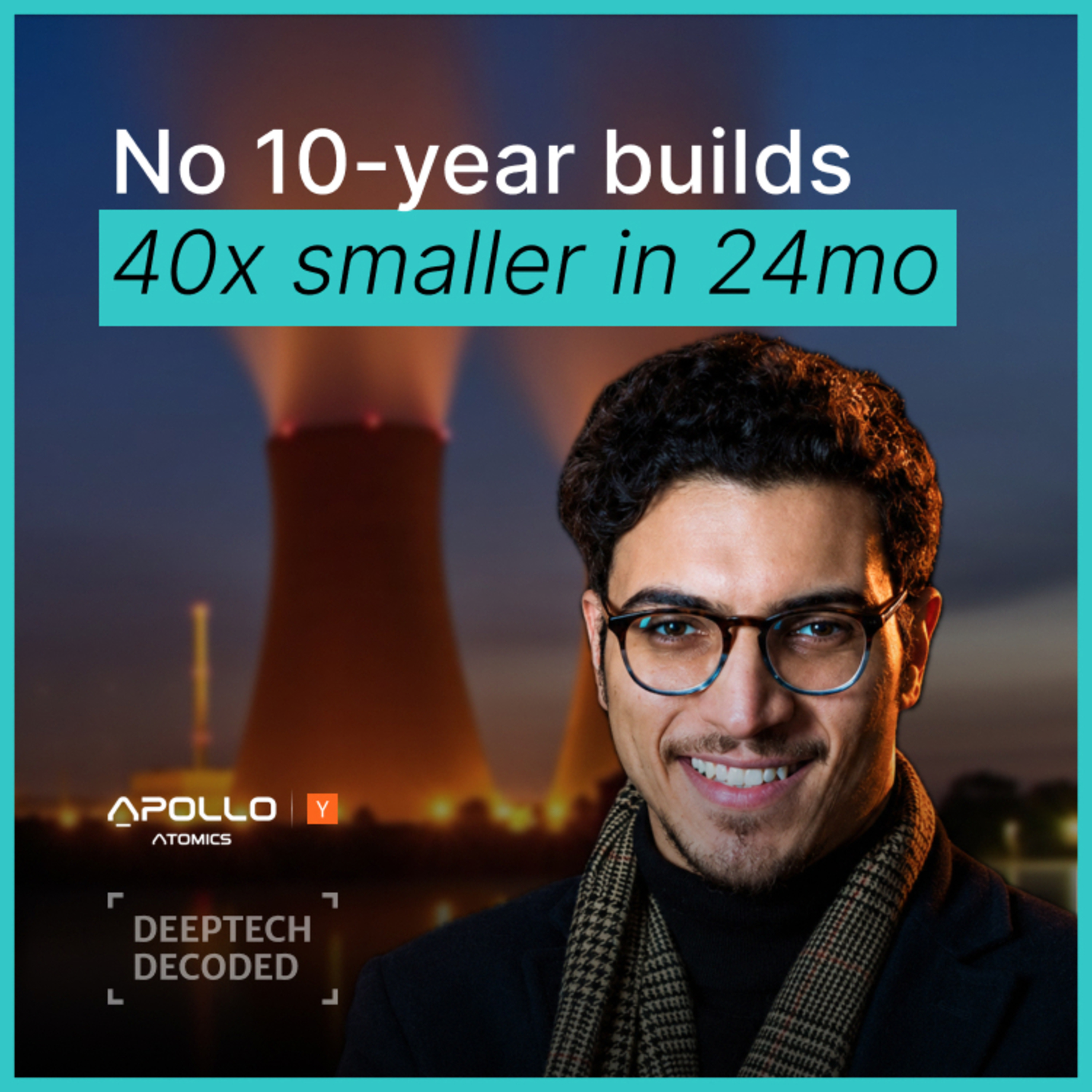
AI × Quantum: YC’s Bet to Turn 27 Years of Work into 2 Minutes | Brandon Severin, Conductor Quantum

The reasoning layer
Decoded before it's obvious.
Transcript
So hi, everyone. This is a very unusual setup, I guess, like that the idea was, you know, that you claim the conversations when you were in the campus and the university and then you just want to, you know, randomly get into a room or in a cafeteria walk into somebody and learn something that was actually the initial the very it came from. And then you were like, okay, why don't we then have conversations with the folks who are building at the frontier? And afterwards, make it a kitchen table size conversation so that it doesn't turn out to be a webinar, but rather everybody gets the chance to have a conversation after your questions. And as a part of the privilege, I will be leading first and I will have more than one conversation for you, And after like probably like 40 minutes of you and I having warming up and getting the insights foundational part. ⁓ Then we are going to open the room for the questions and then you will get to meet the folks that we have today here. Yeah. And other than that, I think that's all we have. If you're ready, I'm happy to get started.
Hi, my name is Brandon. I start with that. ⁓ People then typically say, well, where are you from? Your accent sounds a bit weird. I can't tell if you're British or American. And then I reply, Well, I now live in the US.
Yeah. So what I typically start with is that. we're building the next generation of computers. and rather than computers which will be great for memes and cat videos, ⁓ we're building computers that will help solve problems that we don't really understand as a human being. or as a human species and those are typically things like designing new drugs ⁓ or medicine, ⁓ designing new catalysts for the environment or new materials for aerospace. is where I normally start with because that's really the major benefit that quantum promises. It's not necessarily going to help you watch Netflix at a higher resolution. So instead 4K, it's 8K. It's really going to fundamentally change how we view the natural world around us.
Yeah, great question. I think we'll start with why you should care. And you're right. You don't have that much to do with, let's say quantum computing and building the technology. But the everyday person also isn't building GPU clusters or designing new silicon chips. ⁓ But they are directly impacted by that research and that work on the frontier. ⁓ by just using tools like chatgpt.com because that all benefits from companies such as Nvidia, TSMC, Global Foundries making these excellent high quality silicon chips and GPUs that we can now have computers that pretty much pass the Turing test. And so the future of those quantum is rather than computers passing the Turing test, and us achieving let's say AGI, I think what we're going to be looking at is ANI, maybe artificial natural intelligence, where instead of prompting GPT saying help me with this essay, it's, you know, given my, let's say latest ⁓ blood test results from a doctor, what do you think the best medicines for me would be? And rather than it being based on, let's say, hundreds of years of scientific literature and tests, it's actually based on fundamental tests and science that can be run on an actual quantum computer. And if you extrapolate from that, there's the medicinal side, but I think one great example of where this feeds into our everyday world is the food we eat. is often you know, farmed in an industrial way and we can feed the world because of excellent fertilizer. To make that fertilizer we require ammonia. Ammonia is made by a standard process known as Fritz Haber Bosch, which was, you know, came around the second and first world war, but it's very energy intensive. And without that process, though, we wouldn't be able to basically feed, you know, the eight billion people we have on the planet. And then some coming up, there are many people who actually have more food than, you know, the bottom four billion. And that's another discussion to be had. But that process consumes about five percent of the world's energy usage runs at 400 degrees centigrade in manufacturing ammonia. Now, When you look at nature, there exists cyanobacteria that can manufacture ammonia at room temperature. And, you know, these tiny little bacteria just chilling there in their little solution, and there they are making the ammonia. And then, you know, the undergrad says, well, why can't we do that too, right, you know, in their chemistry class? it's, we don't understand how it works. So we can't replicate it.
Whereas with a quantum computer, you can start to really get to grips with what those fundamental reactions are, these building blocks of the natural world are, and then start to understand them and therefore replicate and generate them. And, you you solve that problem, that's 5 % of the world's energy usage. gone effectively and you have a very nice sustainable process of manufacturing ammonia that we haven't seen before as a human species.
Actually, when you said that undergrads are going, ⁓ why can't we do this? Probably that brought me to the point when you were literally walking in the campus or in the park and then you called your co-founder and said, I think we should pursue that. Do you want to tell us a about that origin story? Because in the end of the day, I'm pretty sure you didn't. And when you were seven years old, you didn't wake up saying, I'm going to study quantum computers. Right? Like perhaps a little bit of like backwards to understand where was the first spark and then how did all the events add up to today? And we're talking about if you manage, it's going to be an amazing breakthrough for every single person who has wifi and laptop.
Yeah, the introduction to quantum. started during secondary school, high school, as they call it in the US, ⁓ you know, this weird spooky thing. You'd hear about these materials and, you know, such as graphene and it's like, okay, well, how can we understand how graphene works? like, you get to grips with bit of quantum mechanics exposure. So that's really the initial seedlings were planted, but I didn't really understand the entire impact of the quantum computer until I got to university as an undergrad and I think it was just very clear studying material science at Oxford you spend a lot of time learning about engineering alloys you know hard things like steel and aluminium and titanium and you learn about how these materials are made and why they're made in a certain way if you want to make a Coca-Cola can versus let's say a vacuum chamber to put ⁓ you know, a shift into outer space. And you quickly learn that actually many of the things we know about these materials and how to make them were done completely by trial and error. And when you get to more advanced materials such as nickel superalloys, which are these amazing materials which consist of mainly nickel and they're often single crystals of nickel but with 20, 30 different elements added in just at the right percentages and weights of percentage to allow you to basically fly from London to San Francisco for $400 instead of $2,000. ⁓ due to the temperature they allow jet engines to operate at. It's like, well, how did we figure that out? well, we kind of have a model, but we also just had to try all these different combinations. And then being in Oxford at that time, you know, when Oxford Ionics was being founded by Chris Ballance, which recently got bought by IonQ, ⁓ Oxford Quantum Circuits. And so quantum was really in the air. was kind of like the right place, right time.
Yeah, and you know, yeah, just it was different. I was studying engineering alloys. I was like, well, okay, let's get to the grips of the base of this problem. So I applied for this PhD, which was think the original title was like read out of quantum devices or quantum semiconductor devices and worked on my PhD. The first few weeks were some of the most painful weeks. of the PhD because I quickly realized that despite looking and watching these videos of Google and IBM, you know, saying, we have 10 qubits at the time or 50 qubits. A lot of the work to get those qubits was done completely manually. And there I was with a different technology. So these semiconductor chips also doing manual work, trying to get one qubit. And it took me weeks to just get like halfway along that journey. And I said to my supervisor, Natalia said, like, never again, sorry. Like, this is crazy. Yeah, like I want to pass the PhD. I don't want to be here in a twiddling knobs. And she looked at me like, you know, what? Like, this is how it's done. But also she was like, well, look, we're, you know, we're thinking about automating this, this whole process. Maybe you look more into that. You know, I have another PhD student looking at that.
And so I went down the automation route of, how can I automate what I was doing in the lab of turning these voltage dials, you know, looking at the current signature and saying, that looks like a potential qubit that isn't. And I did that for the next four years, but it was, was very, you know, academic. was, okay, this would be cool. You have the narrative of it will help scale this technology. But it wasn't until the last year where I went out to Sydney and, you know, worked in a lab there. It was with a professor Andrea Morello who was like, look, know, the software would be great if you could help us speed up experiments. And you know, went out there for six weeks, showed how it worked. like, you know, maybe stay a bit longer. I ended up staying for a whole year. I also worked through the quantum company T-Rack out there and helped them understand their qubits a bit more using AI tools that we built. And so I was like, oh, maybe there's more to this than just academia. This is actually critical in building the hardware. And that's when I went back to Oxford and met my co-founder, who was also working on a similar thing, was automation of these systems. we're like, you know, I just walked into the office. was like, who wants to build a quantum computer? And he stood up. He's like, yeah, I do. let's chat. And so Joel and I, went upstairs and said, look, you know, this is what we think we can do. This is what, why we think it should be done this way. And, you know, the rest was kind of history. think the big thing that we aligned on was really believing in how AI and automation can help scale this technology. And the key word is scale. We weren't really thinking about getting one or two qubits and then three and then four. We were really thinking about from the beginning, what's required to make a million qubit machine, because that's actually what's required to, you know, get this technology out of a place where it's useful for people.
Jean Top But then that actually because this previously you had told me well, it was actually literally how it happened. literally asked. It's like I haven't met at the same time because what are the chances that also you will have this good chemistry between you and your co-founder at the same time complementary parts. Also, I'm interacting with many PhD people.
I see many transferable skills between entrepreneurship and actually PhD area, unlike the majority, which like a little bit encourage the people who are currently at their PhD or living their PhD. But sort of things also make you realize, uh-huh, if I actually go build my own company, I'm going to have the society in a better scale than continue pursuing academia.
Yeah, the first thing I'll answer that question backwards. The first thing was speed. So just doing it as a startup as a company is a very different game versus doing it in the lab for a nature paper. ⁓ Your sort of KPI is completely different, to put it plainly. And then two, because you want to do things at speed, it means your willingness and also access to pursue or access to resources also changes. So you're no longer doing things for an academic exercise, you're thinking about scaling. And I think that was that was the key understanding. that Joel and I both had when we started this company. The other thing where the the PhD is complementary is just your ability to endure pain. think one of the best things about my PhD was that it didn't really work that well until very late towards the end. ⁓
Well, you know... Looking back, you could argue it's a very successful PhD, like I published some papers and whatever, but I don't think that should be the measure of success of a PhD. I think the measure of success should be actually how much you get to learn. Some of the best PhDs that I've seen are the ones where they spend 90 % of their time debugging things in the lab by themselves painstakingly. But what happens is they end up getting a very good understanding of the system they're building, its pain points where it can be improved. ⁓ They will know that system better than anyone else versus someone who comes along and the system's already set up for them. And it's like, okay, cool, click this button, press that here. I have a Qubit and it works great. And I can publish my paper and then publish another one, another one. I think the first person is much better prepared to one, go on and be a very independent researcher because they've had to go through those trials and tribulations themselves. But two, also go through something enduring like building a startup because that's effectively what you're doing every day is debugging everything. Whether it's code, products, customers, contracts, it's just pain, pain. No, no, won't work. And you just have to persevere nonstop.
Yeah, that's a great question again. what we did was, obviously I spent a year in Sydney, So I wasn't like in Oxford when I came back, we're like, look, how about we hack on us other project together to see if we like working together on projects. We were also working together in the lab. I was officially his postdoc. was a PhD student and we were there assembling fridges, counting cables, wiring up devices, measuring devices. But then outside the lab, we were hacking on a project, an idea that Joel had called Feynman AI, ⁓ or just Feynman, which was an AI science researcher system.
Exactly. Yeah, we had a lot of fun with that. ⁓ Because it was a tool that we wanted and it was a tool that we needed, you know, at the time, it's like, okay, you have this amazing kind of little database brain called chat GPT, let's upload our papers to it and then ask it questions about the paper. And it's like, okay, that's great. Anyone can do that. But can we feed it in with like a whole sort of reference management software? where you can take notes, you know, kind of like Mendeley plus GPT, but then also ⁓ an educator based on the papers I've read and the questions I've asked Feynman. What Feynman should tell me what papers I should read next. And so that was good fun. We built that out. You know, we got some initial traction. It was I think it was just it was at a time when LLMs were kind of new on the scene and they were doing well, they weren't new, but they were, you know, they were working quite well. And so it was like anything was possible. But we also quickly realized that, you know, the moat in that field, I mean, in any startup is speed, but it's very much pronounced on anyone who's building on top of one of these foundational models because
At the time, what you're banking on is basically, well, we can do all this extra wrapper stuff that they will never do because they're not focused on that. The joke is that, well, if the model gets better, you won't need the wrapper stuff like vector databases and things like that, you know, if we want to get more technical. And we also realized that we were uniquely positioned to build
what we wanted to build in quantum and life is short. So it was just like, what are we doing? We're not, know, we didn't go through the pain of four years of PhD to just like do this other stuff and get like run over by open AI. You know, we want to have an impact like.
Yeah. Ready. Thank always hear PhD and pain in the same sentence. don't know. They're very opposite. But that was interesting that you actually, your very initial thing to leverage was decision making, right? Like you wanted to make sure that you have the best resources and then you have the, ⁓ how say, you leverage that to save time and also to assess the quality of the input that you take before making decisions.
And then perhaps then now today in your day-to-day work, it's not like you have ample resources. At some point, also people are counting on you, they are backing you up, and then you're trying to speed things up as much as possible. What sort of decision-making is happening in the office, like when you, as a team, when you start working on? Literally, I'm literally curious around the facts or...
Mm-hmm. Yeah, no, does. In fact, actually, these are the things that interested me most before doing a startup. ⁓ Like, almost the internal operations. What does it actually look like? You know, and how do you move? What does it mean to move quickly or move fast? So I think this is where we're quite unique compared to any other quantum company out there is we basically we run it.
as close to a SaaS startup as possible. So we literally do two week development cycles. And this is something we learned before getting into YC just by like, hungrily reading as much information put out there by founders such as Michael Seibel, Tom Bonfield, Paul Grahame, you name it. So basically YC partners. And I think it was Michael Seibel, has a blog about development cycles and how they did it at Twitch or which was previously known as JustinTV. And so we basically follow that rubric and it's a rubric we had at Feynman as well. So we kind of did that was like our training wheels in a sense. And so the two-week development cycle basically means that
we set the KPI we want to reach for the next two weeks and we try and be quite strict on that KPI even though we're a quantum company that's doing deep tech it's not like okay you know launch this feature it's like no like maybe we want x number of stars on our github or we want to close X number of contracts with other content. And natural like, know, tangent, like real goal that's numerical or you wanna, I don't know, increase the launch rate by two X. last development cycle, we launch a product once a week, this time you wanna launch two products each week. And then...
Yeah, models, yeah, for example. So in our case, it would be machine learning models, ⁓ or it could be control software. So we actually recently, as of today, we launched ⁓ a new control software ⁓ suite. Yeah, that was in the dev cycle, that's true. And then we basically followed that rubric where we decide, okay, well, what are the things we need to do to reach that KPI? ⁓
And then we grade them easy, medium, And then we argue over which ones should we do. We start with the ones that have been graded hard. And by hard, it's like the amount of time it takes. So hard is the entire dev cycle. So this thing will take two weeks to launch from end to end. Easy is like, it'll take a few hours, maybe a day max, mediums, half a week, a week, that sort of idea. In fact, actually even made it fine. We have like super easy, easy, hard, and then super hard, which is super hard, it's like longer than an entire dev cycle. But yeah, we start with the hards first and we just argue for hours. And then once we've decided, we then spec out the ideas exactly as they need to be built.
all the way down to the documentation, the function names, everything. And the reason why that's really important, and we've we learned this all the way backwards Feynman, is that when you spec things out precisely, you can no longer argue that for the next two weeks as to who's doing what and how it's supposed to be built, and I want the button to be yellow, I want this one to be blue.
You know, you're all there looking at the Google Doc whiteboard, whatever you use saying, this is how it's going to be built. OK, we agree. Cool. And then we shut up and get back to work for the next two weeks. And of course, we'll have ideas in the meantime. Because you learn things as you go along and I will have a.
billion ideas, you know, it's really our job as founders, and I to come up with ideas every second, every minute and think about, how can we, you know, inch our way closer to our goal? Are we missing extra bits of leverage that we're not thinking about? But we obey the dev cycle and we put those ideas, we write them down and then the next dev cycle, you know, we can bring those ideas up and deal with them. And it's coming, and I think it's important it's a two week cadence because then it's like,
Let's say you come up with those ideas and you're doing, you know, dev cycle every month or three months. You can't, you could be dead by that, right? Like, you know, and yeah, yeah, exactly. Right. And so, I mean, sometimes there are certain things that we learn when we're building something out. And let's say one of the tickets of the dev cycles more exploratory and we quickly learn, this just isn't going to work. And yeah, we just have to pull, you know,
CEO, CTO car saying, okay, cut it here, move on to the next one, you know, and move on. Like, that's the nice thing about being a small team. So that's, that's really how we get kind of the ball rolling internally and how we make those decisions. and a lot of the decision making and the feedback on that. you know, those tickets and what the KPI should be is based on one, our own tuition, because what we're building, we're also building for ourselves. You know, we know the products very well and what we'd want as quantum engineers and researchers in the field, but also talking to other people and customers and partners and like, you know, it'd great if you had a model that did XYZ. It's like, ⁓ okay, we knew you wanted to build that, but if it's important to you, let's build it, know, sooner rather than later.
Mm. But I love the fact that you mentioned highlighted that because very often I speak and I speak to like diverse, let's say range of founders. So how is the feedback? What feedback? The feedback, right? ⁓ no, this is very complex. We first need to build it and then we need to reach out as actually, no, in the end of the day, there are human beings in those companies too who need to use and you don't build for them. You build with them at that very early.
and if they're not interested, then probably not right people to build together. So probably for you also, this is also a matter of speed to spot the people who back you and then say, my gosh, let's just do this together. I will make sure that you have all the answers from my side at least. I guess this is also a very critical piece, right? Deep tech is not so different in that perspective than
any other, I call them regular, like regular software development. You mentioned also regarding that understanding, are we fast? Are we going in the right velocity? In another perspective, probably you had a very good advantage is that you were in the ecosystem of Y Combinator. Because if you don't know what fast,
Mm-hmm. Yeah, I do. I think it probably the most useful thing was doing group office hours with other companies. ⁓ Where basically you kind of get the original sort of Y Combinator experience in the days of Paul Graham and Jessica Livingston. where you and 12 other founders sit around a table and chat about your problems and your goals for the next two weeks, basically. And that's really where you get an idea of what fast is because you see it upfront. Last week we had 10K MRR, this week we have 50. ⁓ Yeah.
Exactly. Precisely, precisely. And it's like, or last week we wanted to close X number of LOIs, this week we did it. But we, I don't know, did a test flight on our missile or rocket or whatever, for example, to take, you know, like a star cloud sort of, you know, goal, I don't know. And. you're kind of inside this little cooker. But the way I think the way that Y Combinator helps is that the cooker, the ingredients in that cooker, the people you're ⁓ boiling with are good people. They're not assholes, to put it bluntly. And so you get very positive, very much a positive sum ⁓ set of peer pressure.
So, you reach your MRR target? Great. How did you do that? How did you get into that company? How did you close that contract? well, you know, I found out that the CEO, you know, his favorite doughnut is this. He slept outside the office, whatever, right? People, you know, this is the YC way it starts, always very creative. Or, ⁓ you know...
you're doing or you're building a loud space in SF, how did you get that building? Which broker did you talk to? Maybe thinking more of a deep tech sort of thing. And so then you kind of like are constantly like, you know, leveling up one another, but pulling also pulling everybody with you and, know, and kind of a great way to view it. Like I have this mental picture in mind is when And I think this is something proteates because I got exposure to during secondary school being in the cadets, which is when you have to scale walls of different heights on the assault course if you're in like the combined cadet force or army corps. And so yeah, you can do like the six foot wall, okay, you know, probably by yourself, you can do the 10 foot wall just about when you get to like 12 feet.
Yeah, like, yeah, you want you want a team they're pushing you saying go on and someone to like, hold you over. And I think that's a good way of how office hours is viewed. Because still you need the strength to still get your upper body, you know, halfway on that wall, right? Like, but you also see the guy who's already up there, you're like, okay, I can do this too. let me move faster ⁓ because there's also a whole queue of But it's very positive stuff in that sense.
Oh, Tons of anecdotes. mean, as a deep tip star, if I remember when we got in and, you know, we get access to Bookface, which is like the internal social network and you see YC companies and stuff. But then publicly, I saw people in our batch. It's like the first week YC hadn't even started. And it's like, yeah, we've launched us like, geez, Joe, we should be launching. What are we doing?
Speaking of YC, what do you think apart from your technical capabilities, because it's one thing, right, to be able to understand the space really in and out or the problem space, like either way, either you understand your users or bots, in your case, almost bots. And what do you think that YC saw in you as a founder that was not even clear to you? Did you have any kind of like... surprising parts that you didn't give yourself enough credits previously, but then after, you know, getting into that school, then you realize, ⁓ actually, they saw this, this, this also in me. That's probably why they are counting. Because we all know that they pick people because your project can change tomorrow. Like the thing that you're working on immediately get 160 degrees, 80 degrees like turn, but you are the constant. Like all the other variables might change.
Yeah, I don't know. The best person to ask is Tom, our group partner. You know, can throw some, you know, stabs in the dark, but because yeah, I think also going through, I see and seeing other founders, you know, and I look at myself and draw, I think look like, yeah, we are definitely, this might sound ridiculous because
It's like, sure, I have a PhD. And I'm like, yeah, we are technical. And it's like, well, yeah, duh. But I think when you occupy a certain space where everybody has a PhD in the postdoc, it's like you grade yourselves differently, especially in academia. Because yeah, but that's a side note. So.
I don't know, you know, it could have been perseverance, or willingness to not give up our backgrounds, maybe our origin stories more. I don't know. But I think the often where you come from feeds into like, you know, how you do things in a sense, how you approach problems, how much you're willing to just like, yeah.
I'm sorry, I was cursed. But like, like, eat shit, you know, literally like this, know, I mean, it's surfers have a phrase for it. Like when you're learning how to surf, you know, you're just there eating shit getting put to the bottom of the ocean by wave after wave, and then eventually you get it and you catch a wave and away you go like that first, you know.
Hmm. I think that's a quite ⁓ self-reflection altogether. In the end, now to come back to what you're building, what if like I'm throwing your worst-case scenario, that then you're working towards that and then you consumed all your resources. What is your plan B or like where is it going to be the point that you will say?
Now, I am not gonna pursue this. This is the best, worst question to ask a founder, but I'm just trying to tease you in a way. Probably you at nights, there are things that keeps you up, right? And then you think through those things and then it's not the better time, but still, do you have any sort of mental model saying, okay, that would be really like pushing my, all my energy and willingness.
Yeah. Well, I know it's possible because we'll make it possible as a team. And we've done, as a human race, we've done hard things before that seemed impossible or seemed hard. I think another big part is we're not starting from zero, funnily enough. It looks like there's this huge mountain ahead, which is very true. There is. But we are also a very cozy and warm base camp, which is the trillion dollar semiconductor industry that has been developed and refined over the past 50 odd years. And when you look at how that industry has changed from day zero to today, where people are considering putting. ⁓ data centers in space, all the way back to when William Shockley was in his hotel room mucking around with a lump of germanium and figured out that, it can operate as a switch to a trillion transistors being printed on a trillion different wafers every single day by the world's most valuable companies. know, sky's the limit. ⁓ Especially given that we're leveraging that technology to build quantum computers. So yeah, I guess to me, it's like
Mm. Mm. But I'm taking up on the fact that it's so obvious to you that what is the one question you would say, I wish they had asked me more often. I wish they had asked me to answer this question more often, more like to clarify the misconception, one of the biggest misconceptions about the space. Because in the end of the day,
The further away from technology you are, the less you understand. And then again, I got many feedback when I said I'm hosting you. ⁓ yet another bubble. Some people who are not in the text, they're like, no, it's not a bubble. Trust me. you just follow their work, you will see why they are doing this. So maybe then you can wrap it up in a nice way on behalf of all the misconception throwers.
Yeah. Yeah. Yeah, I think that's a great point. And I think the question, I have two questions which I'd ask more often if I was someone. Not that what I wish I was asked, because that's not fair. I could say anything and then I'll just spin that to say how great we are.
And why and then why is it so hard? You know, and it kind of hit me the other day, I was talking to my mom for one of the rare occasions or called her checked in how she was doing. I was like, Hey, mom, how's it going? She's like, Hey, have you have you fixed that issue with the quantum computers yet? I said, I said, No, we're working on it. She goes, What's taking so long? I said, I said to her, know,
It gives you an idea of where I'm coming from and who raised me. And, you know, when we talk about speed, but, so those would be the two questions. Why is it taking so long? And okay, why is it so hard? And I guess your next question will be, well, answer those two questions.
Hmm. I like the way you approach it. have a feeling that I can keep asking you questions and having the conversation. But we also have people over here that would love to engage in a conversation with you. Then Cameron, would you like to take over and be slowly facing to our kitchen table?
Thank Perfect. Awesome. Thank you very much. And it's been an incredibly enlightening discussion so far as well. I must say it's really interesting. From my personal perspective, it feels like you go from quite soft to very steely in your determination when talking about certain things, particularly in the fact that it's just like, we will succeed, we will do this. There is no other path. And I really admire that to kind of echo Nihal sentiments. One question we do have that's come through during the course of the conversation so far, which is what is the threshold in the technology in your mind that will allow scaling similar to semiconductors? What's the aha moment or the it's not a bubble, this is happening, has that already happened? So if you could just, I guess, expand on that a little bit. And that's from a fact within the group.
in Mm-hmm. you Yeah, great question. There's been a few aha moments that have already happened. And those key points are basically like important ingredients you need to be able to build a quantum computer. you know, one of those ingredients is, first of all, can you make a qubit? Is it even possible to make a qubit in a silicon chip?
Thankfully, people did that, you know, like over a decade ago, famously Andrea Morello did it in 2010, where he was able to read out an individual electron spin in a silicon chip, like singly. The next question is, well, how good can that qubit be? Is that qubit reliable enough that you can take out errors in your system faster than you're introducing them? and those requirements were satisfied a few years ago by multiple labs across different semiconductor, which are silicon, silicon, germanium, union. So then the next requirement is how do we scale this thing? And we know manufacturing-wise it is possible to scale silicon chips to have hundreds of millions of transistors or billions of transistors in the palm of your hand in terms of size. So the fabrication is possible. But then it's almost like the gap from today to there. And I think this is where it's kind of like why it's taking so long. And the aha moment is actually, think, now how we approach the problem. So rather than building one-off hero devices saying, look, I have one qubit and then next year I'm going to build a device where I can show two qubits. And then the next year I'm going to show three qubits. That just scales linearly. What you want to be doing is from the outset thinking, well, we need a million qubits minimum. So what systems do we need to build in place now to get to that million qubit mark? I want a server rack. What does my server rack need to look like? I need one transistor. Let me scale that one transistor to the two to a billion to then a server rack. And that process is very much an engineering challenge because now you're thinking of things that you didn't need to think before, cooling requirements. ⁓ algorithm and compilation, ⁓ size, power requirements. There are some systems that, given the power required, just seems ridiculous that they'll ever be built, but you never know, it is possible. Human beings, know, give them an incentive and they will do it, if the incentive is good enough. And I think that almost the aha moment is how we approach that problem. I think there's only a handful of companies that already thinking on that level. Sci Quantum is probably one of the best examples of that. And I think we are the next also thinking that way too.
Perfect, that was a really insightful answer, so thank you. I know we also have a question from Reese who's basically said, what was the process of realizing this was your life's work? I think you touched on it to a degree in terms of your kind of path through academia and then into startup, but maybe if we can just kind of expand on that a little bit.
Yeah, sure. Really funny, I hopped on a random Zoom call with a guy who got introduced to me and I don't know, long story short, he basically said to me like, look, you know, Brandon, like, you're gonna be okay, you're a smart guy, you know, you're well intentioned, you know, you're not gonna be poor. Like, you're okay, you're like, whatever happens will be okay. You just need to decide on when you get out of bed in the morning. How do you feel when your feet touch the ground and you get up and go to work? And I was just like, geez, it's that simple. Yeah, yeah, like, okay, cool. And this was at a time while Joel and I were building Feynman. And we just had that chat, we were like, look, like.
You know, we pursue the PhD in quantum because of these reasons. We did the postdoc because of these reasons. We care about the technology because of these reasons. What happened? You know, we just kind of got caught along in the AI wave. And it's like, no, we actually want to build this thing out. We want to have an impact on the world. And that was really it. was very much. And I think it really was that I just kept asking myself that question every day, getting up, working on fine and doing tickets. was the same. It's like, but we could also be doing and then once you're always asking, but we could always like just do it. Right. Exactly. Exactly. And then it was just never looked back from then on.
going to be dealing with tickets and accepting the pain we could be doing the thing we really want to do I guess. Awesome. Again, thank you, Etan, for kind of clarifying that. Yeah, it really speaks to your drive. I know that's something I've spoken about already, but yeah, it's incredibly impressive. We did have one potentially kind of researchy question, which is probably deeper than my understanding goes in this, but it was from someone who unfortunately couldn't attend. But the question was, if I were to ⁓ hand you a thousand error corrected qubits now,
Yeah, I think. to finally tune the terminology that we should say maybe not necessarily error corrected, but ⁓ logical qubits. This is, I love this question because most people don't have a clue and you know understandably so. The algorithms still need to be built. There's only a handful of algorithms that exist that we know will be of some use. The most obvious one as well, you can start for you know. hacking nation states secrets and hard drives if you believe those states to be a threat to national security. That's the most obvious case you can do with logical qubits. Two, you can start looking at, I mean, you can already actually before that number of qubits, you can start looking at ground state energy of small molecules using things like. solvers and things like that. And there are companies such as phase craft based in the UK where they literally have a list of molecules you can simulate and the number of physical qubits required. ⁓ But that's not necessarily going to tell you that that molecule cure cancer. That's what I want to be able to do is 1000, 2000, 10,000 logical qubits. How I do that, we don't know yet. not going to lie to you, but we know theoretically it's possible because for the first time, your unit of information you are using to do computation replicates the physical system you are trying to simulate. You are trying to simulate an atom, an electron, its interactions with other atoms and electrons, i.e. an antigen and an antibody. What best to use that other than other atoms and electrons that you can program and manipulate such as a quantum computer.
Wow. That's incredibly insightful. Again, it's interesting to hear that compared to, I know we've talked about the journey through Y Combinator and academia and what set you up as a person, I guess, along that path and what made you stand out and yourself and your co-founder. So it was really interesting to hear you go in depth and see the light enter your face when the question came up.
So I know we are at the top of the hour. What I think I might do is any questions that kind of come through later on, we can always kind of connect and we can kind of put you in touch with maybe some of the people that were here to ask some questions as well. I would ask Thitni Hull to jump back up and as our mistress of ceremony, so I'm not sure if that's word, can probably wrap everything up.
Yeah, actually I was also reflecting when you were explaining the details that Brandon, what do you let's say, pass forward to three, five years later and everything work as you ever imagined it to be? How do you see our day to day lives are going to be changing? Like how are we going to
feel it in the industry and how are we going to feel also in individuals lives? Because earlier you mentioned also LLMs were new but not new. For the ones who were in the field, they were actually not new. But for whenever the moment CHPT went out, made it on scale, then that was the, okay, now I touch your life. Now I have you to do things in a different way, different pace. What is your picture?
early 2014, 2013, where, oh, look, we can do cats and dogs and classify them. you know, we can start to add captions to images and, oh, wow, we can beat world chess champions and go champions. And be like, yeah, cool. It's coming maybe 10 years away. And then in 10 years time, you have this chat GPT moment. I do, it does feel like we're at that early point in quantum in this chat GPT moment is on its way as we look at scaling these systems in the coming years, decade, and maybe a bit more. How that looks like is...
The same way today in that what LLMs have done, I think one of most obvious answers is... it's kind of shown by some of the more valuable startups and fastest growing startups. What LLMs have done is they've been able to turn everybody into a builder, right? You no longer need to go to a coding bootcamp to build a fantastic website or B2B SaaS product. You can go on lovable.dev and code up, know, your own tool, your own website, anything you can imagine that basically, but the friction between idea to building the thing is
and super cheap. I think that's where quantum will change our lives, where rather than the idea being software, it's more natural world ideas. So if I'm in person in industry, it's what does this molecule need to look like? What did the binding sites need to look like? How many ⁓ or oxide groups do I need? idea to friction, idea to building on things, way in reduced to zero. But then for the everyday person, oh, I can start to understand the natural world in ways I didn't before. I think it almost changes education in a sense. Because now it looked like it's one of these things where it's
We say it'll be amazing, it'll be great, but very, I think it's very hard to comprehend what that means. You know, and I kind of have an idea, but I know it's gonna be kind of wrong. ⁓ Because, you know, for the first time, when this when this plays out, it's, ⁓ you know, bacteria does this because of X and Y, and we know exactly.
Protein structure looks like this, not because of AI prediction, but because we can simulate it exactly. Okay, protein binds to this or ⁓ antiviral drug does that. ⁓ maybe we don't want drugs with any side effects anymore. I don't know, GPT quantum or conductorquantum.com. ⁓ Here's my whatever.
Yeah, that actually make me think about when I was in the university, I look younger, but I am older than how I look like. We used to run simulations and leave the computer on, like literally on and making sure the cable is plugged because if it stops, then I need to start from scratch. I don't want that. And actually, if you take a look back at
Okay. Yeah, but here we go again. Yeah, another one of those. I think honestly, the point you raise is really good because the difference with quantum is it's not like of, you know, two weeks to two minutes. It's impossible to possible. So it's okay. I want to understand how a caffeine molecule Right? I have my cup of coffee, tea, coffee. I'm drinking coffee these days. American, they got to me here. But you know, how that interacts with adenosine receptors in the brain. Why does it keep us awake? What's the caffeine half life? Why am I more susceptible to coffee than tea? you know, why does it, you know, take all the supercomputers in the world. Stargate, you name it, Colossus, put them all together. Try and simulate that problem precisely. It will take you the age of the universe. You do it with a quantum computer. theory, you're getting that result within an hour or so. So this is what I mean by like. Sure, yeah, if I coat up a molecule, but then the implications that has on how we interact with each other and what the natural world looks like, I don't think we can actually comprehend yet what that world looks like, because it's very, it's very different to the one we've always inhabited, whereas we come up with laws to
map out the way the universe works, know, Newtonian mechanics and then, actually, when things get very small, it's kind of complicated. have quantum mechanics and ⁓ maybe they're related with quantum gravity. We'll see. You know, versus, ⁓ I can just run, I can just run the code and see how it works for real.
Mm-mm. If you get into something you would otherwise never know. It will be all hidden in the universe and nature knows but I don't know. have no clue. That's also the nature of the problems are of course different and normal binary versus quantum computing models are trying to solve. at the end of the day, it's again the capabilities are getting so advanced also that
challenges you probably on your day-to-day work too that you need to be really at the top of your all news, all the latest trends and technology that you leverage insights where you are working. How do you fit that overall? How do you make yourself not overwhelmed with everything being going so fast, but at the same time, you're selectively picking the right things to channel into your work?
I mean, I guess this is one thing I've seen develop in myself is, yeah, it's just the degree of focus. ⁓ Because you want to reach your goals and every second, every minute counts. So you need to... weigh up those seconds very well. You know, I I have a priority list and then I'm consistently reprioritizing that list as more information comes through by the over the two weeks of the week over the day of the hour. And there's only, you know, a number of things I want to get done on that list. Literally, it's a sheet of paper that sits on my desk every day and then you just focus on knocking down those things. Yeah. It's also the physical thing. It's like one sheet. So you can only fit so much if it's digital. So I have a long digital list and that can go on that. If a nine number, the sheet of paper is like, okay, cool. This is manageable.
Yeah, yeah, yeah, And then you keep questioning, okay, which one do I stick to? No, it's a hybrid. But you can actually do both because I'm not going to put the link on my paper. So I also need that. Yeah. But I actually to wrap things up, I'm wondering what will be your message for anyone building in Deep Tech space in today's conditions?
Is anyone in the room who would like to themselves or say hi to Brandon? Let me ask publicly if we... Are you guys being shy? Okay, this is very shy.
Yeah, maybe. Yeah, but I think it's also, you know, it's our job to educate people as well and bring them along for the ride. You know, this is something Joel and I talk a lot about this really. Sure, we're very much involved in the tech and, you know, we control individual electrons tunneling to the left or to the right in the silicon chip, but it's like, okay, who cares? Like, what does that mean for me? You know, can I run Fortnite on this thing or not? Right? Like.
Yeah, I'm trying to build something in deep tech. So your last message was very, very resonating. Just build. I'm good on you. That's exciting. I basically am at University of Arizona. I'm also doing a PhD. So I can relate to a lot of things that you said. Going through the process of the PhD is brutal. Like initial four to five years, you're trying to figure out where I belong in this.
the world and what do I do and how to kind of take it out. One thing I find and maybe you resonate with it is that the current modularity of academia is not conducive to build at the scales that you're talking about, like what you can do potentially in the industry or the way Y Combinator teaches you or the year that Y Combinator show you that you need to go this fast to do path-breaking things.
⁓ Is there any hope? Is there any way we could have this fusion between industry and academia that works at an intersection where building things is fast and we're able to utilize the resources that exist in academia? There's a lot of intelligent people who don't really want to transition to industry. There's a lot of resources like labs and facilities which we can benefit from at startups, but there's like this whole dichotomy or one way or the other.
Yeah, yeah. Thanks for your question. ⁓ Yeah, I think, I think there's definitely ways in which these worlds can collide and work together. I think it's just a matter of what's the problem at hand and what are the incentives, you know, a great example are things like the, you know, the nuclear fusion project. ⁓ you know, as an eater, you know, in the UK, in Europe, or even looking further back, know, ⁓ which has its political issues, but you know, the Manhattan Project as well. ⁓ But I think it's important to also recognize that academia has a very important role to play by itself, you without ever touching startup land or deep tech land, is, you know, we can view it as effectively what it is, which is a school, it's training, you know, you're teaching some of the brightest minds like yourself, you know, how to do excellent research and excellent work and. without the opportunity to fail a million times with zero cost or zero impact on, let's say, a company's profits. That's what allows you to become a world star researcher. Companies don't actually often afford that opportunity because they're working towards a different thing. ⁓ So, you know, although you can't move as fast as academia, I I probably wouldn't, you know, be here and be able to just set up a lab completely by myself. Had I not gone through academia and been able to learn, you know, at my own pace and figure things out without, you know, a boss saying you're fired, you know, kind of thing. So. Just also important note there and. You know, I think we're seeing more and more of this sort of interplay between academia and deep tech startups because of that previous point, is academia often trains up these great brains and great minds. ⁓ But, you know, deep tech startups is where they can have the resources to go and leverage or lever up and build a thing at scale. And whether that's government funded or jointly government and VC backed companies, you know, we're seeing it time and time again. And it might not seem like it's academic related, but when you look at the places that people are coming from, know, SpaceX engineers, know, GNC engineers, they're all PhDs, right, you know, or the researchers are open AI, PhDs, know, in AI machine learning. You can only get a PhD from one place, right, which is academia. So think will that pipeline become smoother? Maybe, maybe not, you know, because I think the danger of it becoming super. Smooth in that, okay, I did my PhD, now I joined one of these deep tech startups. Then you kind of start to lose your creativity and independence that also ⁓ a PhD affords you, where you can go and say, want to go build a deep tech company or something like that. Or I don't know, start a brewery or work on a farm or do whatever you want to do as a human being that brings you joy and happiness.
I think this having you phasing from technical PhD to life goals, like in the end of today, no one wants to wake up to feel drained or, ⁓ okay. So why am I up today? Like what is waiting for me? Let me get over this day so that the weekend comes and I get my peace on a Monday. think probably Brandon, your life is very difficult depending on who you ask.
Thanks Brandon, will turn my video off, but this is great.
Cool. Cool. Thank you for a nice talk. Very interesting story. My question basically is kind of given these longer timelines associated with deep tech inherently, ⁓ especially funding timelines. And you kind of alluded before with this two week kind of cycles for KPI and for KPIs and so on. So what do think is the optimum strategy to kind of balance this kind of lean lean tech, lean startup methodology in deep tech, which I think is not really applicable most of the times, given how, you know, how different it is from like a software company or like any other company in my opinion.
Yeah. I think, I think you can. And I think, I think you should try and actually have that sort of very fast two week-esque cadence across the entire company. Try really run it like a startup where, know, you, rather than looking to build something, let's say, it's really, you're trying to find the truth as fast as possible. ⁓ And, you know, the typical deep tech ways, you know, we hire a bunch of PhDs, we're not sure if this will work, or we fund PhDs, and let's get a PhD to work on that thing for three years. Three years, you don't know the answer to that question, you know, whatever it is. And ⁓ That's a third of a typical venture backed company's lifetime, right? Until I exit, let's say in 10 years versus What can we figure out in the next two weeks to make sure we don't burn three years of someone's life on this thing? ⁓ There's a very different mindset. And you're right that there will be some problems that you just have to pursue. But, you know, you choose the right ones, it pays off huge dividends. I ⁓ actually, I guess the truth is, yeah, I disagree. think you have to have that mentality to get there with a very much with a deep engineering mindset, though. So it's not just like, and spray. It's like, okay, you know, taking this decision doesn't lead us closer to the overall goal or is this one an exploratory one? Okay, how many exploratory things do you wanna do in these two weeks? At the end of the day, we still want, let's say a million qubits, you know, and are these other things getting us to that KPI at the end of the day? So I guess this is almost like the balance you have to strike as a founder, very much determines on this sort of company you choose that you want to build. You can see my bias already, which is very much to still keep that lean startup and try and move as fast as possible.
Cool, thank you. And do you think this can be applicable to more fundamental research as well? So say you're researching a topic which is 60 % fundamental and it's 40 % how there's like, no, it's 40 minutes like too much actually, 80 % fundamental and then 20 maybe has some technological applicability.
Yeah. Yeah, I think so. You can always adjust the time scale. So rather than working on two weeks, maybe you do like a monthly or a quarterly one. I think you should always have a time box, though, because that is a forcing function for you to find truth by a certain date rather than, ⁓ well, we'll never know, you know. Just that not having that deadline means you naturally dilly dally, you'll naturally procrastinate. Dilly dally, the British ton of phrase. You naturally procrastinate. You're thinking, ⁓ I could do this, I could do that versus, ⁓ I gotta find this out and report back to my team by the end of the month. is very different sort of mindset. But conversely, if you're doing that fundamental research, let's say it's technical or can be commercialized or not, but you're being trained, you're a student, you're just purely exploring, you're learning how to use the instruments at the same time as trying to build a thing, I think forget about it because you're there to learn how to fail. If you see it like, think part of my PhD would have greatly benefited had I worked on two week time scales, but other parts of it just wouldn't have been possible because I had to learn that, when we order a dilution fridge that can cool to the coldest temperatures in the entire universe, it takes a year to get delivered. Okay, well, that's that for two weeks, you know, like, and then when it arrives, you know, I need to learn how to use the thing. And that's going to take longer than two weeks, I need to figure out when it breaks, what do I do? You know, then you're kind of playing the role of student and learning. Versus, okay, you know, the training, you know, the experiments you need to run. That I think you can start to timebox a lot more.
And I guess when you are time boxing yourself and the team, there is this really aspirational timeline that motivates people. wow, if we get it done in let's say like five days, that's going to be amazing. But at some part, you also know it might be perhaps like more than five days. think my, but what's best for you to make it in a systematic way? not to delude, not to cheat yourself. Yeah, I'm gonna now put another one week, but then there's evidence, there's the fact we need one more week or, ⁓ we were totally off with the timeline. It's not gonna work. It's also in the end of the human beings making a decision and reset those timelines quite artificially.
Yeah. yeah. 100%. we try and get better and better at this and we see ourselves getting better where it's like, oh, okay, this task should take a week. You know, maybe we'd say that a year ago. And then it takes two weeks. And then we see that reoccurring. We're like, OK, actually, this task is, you we know that down. We make it, you know, keep that data point. OK, this is actually a two week sort of task. So it's important to actually log that data point. If you just like kind of remember it in the back of your head, you'll never update your next judgment. you always have that next dev spec cycle meeting where you can say, look, this took longer than expected, and I think it's worth pursuing, and here's why. So you kind of go through it again, and you argue that that's an important thing to work on. ⁓ But you know, like, You're completely correct. It's very much human nature. And I think human nature can bend either way, where human beings can either set themselves ridiculously hard goals and timelines and ambitions, and they will strive really hard to get there. Or you get other human beings who will set super easy goals and super easy ambitions and you know, they get there too, but at least they get there. So, you know, there's almost like a balance you need to strike because some people are motivated by striving to, you know, get to the sun and you reach the moon and others are like, but we didn't get to the sun, geez, what are we doing wrong?
It's something we figured out internally. think every team is different. It's very much almost a culture thing. And that culture is really defined by what you're doing, not necessarily what you say you need to do or what you think. It's actually what you physically decide to do as a team.
This conversation is so beautiful but I aware we are already 15 minutes over running. I want to kidnap Brandon and ask him another one hour of questions.
Thank you so much, Brandon. And if there's anything we can help you with anything, we're always here cheering for you.
Definitely. ⁓ amazing. yeah, I think we will definitely host you again ⁓ sometime in the future. But it was really amazing to have you over. You're such a brilliant mind and human being at the same time, because you're for someone who has this vast knowledge and reasoning skills, you're so modest. think kudos to your parents, guess. Like really, it's... It was a really ⁓ very nice conversation with you. I appreciate that.
No, honestly, no, for me, it's always fun and interesting to talk about quantum with everyone because I think, look, like, I think that's probably the most important thing I can do as a founder of this company is, you know, bring the rest of the world with us. So really appreciate you having me on and giving me the opportunity to chat with everyone. So thanks.
And we will make sure the world also surprised as far as it could. Have a lovely day, rest of day, Brandon, and take good care.
Moments
- Why quantum matters to everyone: ammonia, fertilizer and 5% of energy
- Weeks of turning knobs by hand to get halfway to one qubit
- Automating qubit tune-up, from Oxford to a year in Sydney
- Running a quantum company on two-week development cycles
- The aha moments behind scaling silicon qubits to a million
- What a thousand logical qubits could actually do
Keep listening
Recent conversations
20 Years of R&D. Matched in 3 Months by 2 Friends. | Advaith Sridhar, Discovered Materials • DD15
Rocket Cargo Anywhere In 15 Minutes. The U.S. Air Force Is In. | Matija Milenovic, Hop Aero (YC S26)