EpisodesConversation

Conversation

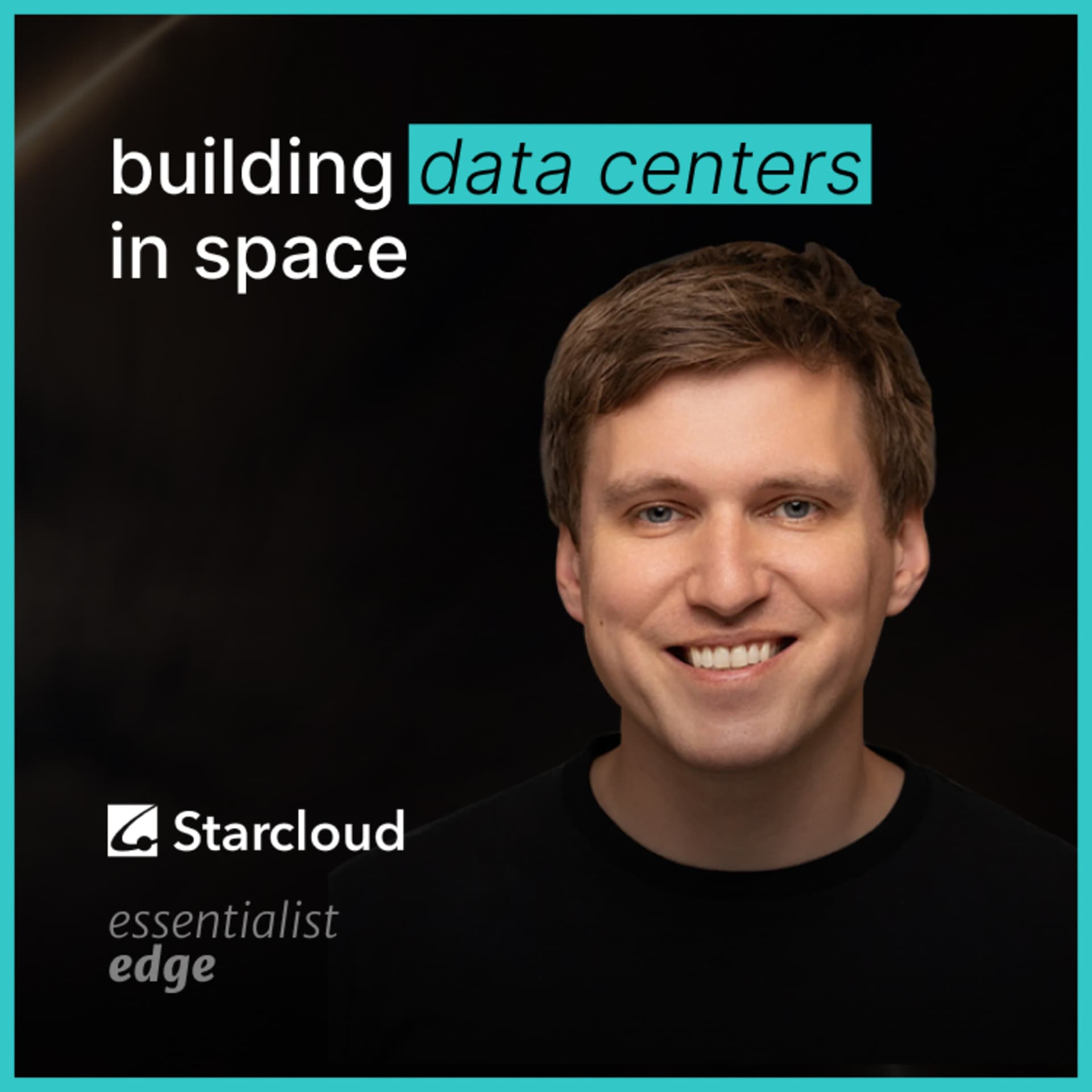
Data Centers in Space: The Future of AI Compute | Philip Johnston, Starcloud

51m
Data Centers in Space: The Future of AI Compute | Philip Johnston, Starcloud

Transcript

In this conversation
Nihal

Everyone, my name is Nihal. I'm riding at Essentials Edge and building at the price, and today I'm so happy to host Philip together with Seline...

Nihal

So we have this set up here today. I think I can get things started and give a little bit of context...

Nihal

Uh, now there's big of a change and in initiation. And today's guest is building one of the first orbital data center companies and welcome to the show, Philip Johnson and founder of Star Cloud...

Nihal

And of course Philip will explain it in much detail in the moment. But just to set the stage β€” imagine a floating factory in orbit...

Nihal

That's what Star Cloud is. Building a compute factory in orbit. So Philip, could you walk us through what a space-based data center actually looks like?

PH
Philip

Yeah, for sure. So maybe there's a few different stages before we get to these very large data centers...

PH
Philip

Each model is gonna be what you can launch on one full Starship payload...

PH
Philip

And the second is you only have launch capacity of about a hundred tons with Starship...

PH
Philip

So these will look like almost like large shipping containers, which on the end have a docking port...

PH
Philip

And then from there, outcomes is absolutely enormous solar panel, with a radiator built in on the backside...

PH
Philip

Um, so yeah, that's the main difference in terms of what it looks like. For the smaller version β€” we're launching a demonstrated satellite, a 60 kilogram small sat the size of a fridge, launching in November...

PH
Philip

And the purpose of that is just to prove our radiation shielding and thermal management techniques allow us to operate data center grade GPUs in space...

Nihal

The former mega structure. Does that answer the question? ...So it's massive and progressively increasing in size every year.

Nihal

And so the reality of building something like that must be wild. My second question is: how do you shrink all that down into something you can launch β€” modular, upgradeable, and resilient?

PH
Philip

I know, but if you think about the trade offs or design choices you had to make... Yeah, for sure. In order β€” you can't launch this whole five gigawatt data center in one go, so it needs to be broken down into manageable chunks.

PH
Philip

And we think it's around 40 or 50 megawatts per hundred-ton Starship launch. Each module will contain everything it needs to be self-sustaining...

PH
Philip

And so even if you didn't hook them up in space, you'd have modules able to operate on their own...

PH
Philip

It's very similar to the way that direct chip liquid cooling works today...

PH
Philip

We hope to partner with somebody who's gonna actually operate the data center themselves...

Nihal

Actually, there are so many follow-up questions popping in my mind, but I'm gonna rewind and ask you the origin story. When you started the fundraise β€” it's always the first check that kicks it off. Your first check came from Russell Long?

Nihal

Sorry. Uh.

Nihal

You created this conviction and hooked one person. He said, "This is either genius or insane β€” either way, I'm in." Can you talk about the investment memos β€” what was the part that challenged you most in terms of risk?

PH
Philip

You end up with 200 plus investors knocking on your door. So usually they don't show us the investment memos, so I don't really know what's in them. But I can tell you the top five complaints...

PH
Philip

Every time I hear a new question, I add a slide to the back of the deck. By the time I've done five or six pitches, I have a slide for every objection. The top five: how are you gonna keep this thing cold?

PH
Philip

Because space is a vacuum. How are you gonna make the chips work in a high radiation environment? How do you handle orbital debris? How do you handle security? How do you handle the regulatory environment?

PH
Philip

So you have to have a well thought-through and plausible answer to all these points. Otherwise you're not gonna get very far.

Nihal

Oh, the last one is how do you handle maintenance when you don't have access for four or five years? These are the top questions β€” Selin and I when we sat down were like, if we were the first check writer, what would we really want to make sure about?

PH
Philip

Yeah. And then lastly, how have you proven commercial validation? How have you proven there are people who actually wanna pay for this? What's the competitive landscape β€” what's to stop SpaceX or Blue Origin doing this?

PH
Philip

There are other people doing data centers in space. There are probably like 20 different questions. But I'd say the first time I pitched to Russell, I didn't have good answers, and I'm still grateful β€” he might have actually been the very first investor call I took and he wrote the first check.

Nihal

After he wrote that check, you thought it was gonna be the easiest fundraise ever...

Nihal

Oh, I love Philip. I love Philip β€” people keep saying that. You're one of the very rare founders that people start sentences that way. Kudos to you for giving back as a mentor. You're blushing a little.

Nihal

So I'd like to take us back to the previous question because Greg has a very good question. He asks: what's your expected mission life for a module, and how do you intend to dispose of modules at end of life?

PH
Philip

Basically β€” what do you do when they die and how do you maintain them? Yeah, it's a very good question because the biggest expense in everything we're doing is the same as terrestrial β€” the cost of the chips.

PH
Philip

One of the biggest levers in making the business case close is the depreciation timeline β€” how long are these chips gonna generate cash, and at what rate does that cash decline?

PH
Philip

In a terrestrial data center, chips last about four or five years.

PH
Philip

We expect similar in space β€” in fact there's a case to be made it might be slightly longer because we don't have an oxygen atmosphere, which is corrosive. We have zero marginal cost of energy.

PH
Philip

We also don't have environmental factors like earthquake tremors. The infrastructure β€” radiators, solar panels, networking β€” can last between 10 and 15 years.

PH
Philip

And so that's why we have this dock-in, dock-out architecture. For initial versions, we expect not to reuse the solar panels and radiators for more than a five-year lifetime.

PH
Philip

If we have the extremely large hundred-ton versions, we may put them in a graveyard orbit, or reenter them with Starship.

Nihal

Yeah. Actually we kind of covered that comprehensively. My question: let's assume something went wrong β€” what's the backup plan? What do you trigger in the first 60 minutes?

Nihal

Because it's not like I'm gonna take my tool set and go to the data center. How are you gonna fix things up there? Autonomous robots, or putting somebody up there?

Nihal

This sounds like science fiction. But the more I read about it, the more I'm convinced.

PH
Philip

Yeah, orbital maintenance is an interesting question. For the first few iterations of a satellite, we're not gonna have access to it. Very similar to how a Starlink satellite works β€” you have redundancy on critical systems.

PH
Philip

Triple redundancy in certain instances. And over-provisioning on aspects expected to degrade gracefully β€” like making solar panels slightly larger than needed.

PH
Philip

So by end of life, you still have enough power. For the first three or four satellites, there will be no access to the data center in space.

PH
Philip

Over time, the space industry is moving towards robotic maintenance β€” you see this on the ISS. Terrestrial data centers are also moving towards robotic maintenance.

PH
Philip

I had a conversation with someone recently who said it wouldn't be surprising if within five years we see humanoid robots maintaining terrestrial data centers.

PH
Philip

So if you put a humanoid robot in a space suit β€” that takes care of thermal management and radiation shielding. It wouldn't surprise me if within five years we start seeing humanoids building structures in space.

PH
Philip

We're not relying on that, but that's my hunch of where this thing's going.

Nihal

So you have five key design principles on your white paper β€” one is about modularity. If one fails, the other still sustains the system.

Nihal

Yes. And you'd also need some facilities, but not as big as typical data centers. How big do you plan to cover on your initial launches?

PH
Philip

When you say facilities, what do you mean?

PH
Philip

That's a good question. We're not going to be doing our own data backhaul β€” we'll very likely be using one of the mega constellations. So we won't need to rely on ground stations or our own satellite connectivity.

PH
Philip

So I don't think we'll have a ground footprint at all really, except for this facility behind me.

Nihal

Got it. But that brings me to the question of cost efficiency. In comparison to other space startups, I find it radical how you iterate very often and keep those cycles short.

Nihal

In order to have these iterations, I need to break it down to small parts and have runway that supports me. How do you balance this? Does your cap table back this up β€” are investors happy seeing momentum rather than short-term returns?

PH
Philip

Yeah, that's a good question. It's quite a CapEx-heavy business at the beginning. There's a few approaches β€” one: spend enormous CapEx building something elaborate, then launch it and hope it works. If it doesn't, you shut down.

PH
Philip

The other is you launch every year incrementally. We've taken the second approach β€” launching incrementally.

PH
Philip

First launch is going up in November this year β€” first H100s onboard, about a hundred times more powerful GPU compute than has been in space before. Second one going up in October next year.

PH
Philip

We'll have the first Blackwell architecture from Nvidia. That one will be the first to provide a commercial service. We want to generate cash from the second satellite onwards.

PH
Philip

Also to be fair, we're doing it cheaply. We raised a $2.5M pre-seed and the whole first satellite was designed, built, and will launch for that $2.5M β€” dirt cheap compared to any other space startup.

PH
Philip

The second one we can do with the seed money we raised. We always aim to have enough cash to survive the next two launches. Right now we have cash through mid 2027.

PH
Philip

We'll basically try to raise after the first launch. If there's a failure, we're not totally screwed β€” we have enough cash to get through to the next one. Our investors are supportive because iterating quickly de-risks it a lot.

Nihal

In this process, I assume you already have prospects or people you collaborate with. Could you open the door on how you do launches β€” how people get convinced to do this together with Star Cloud?

Nihal

I'd be very keen to understand your differentiation and how you hook your prospects. Are you very much "one great customer" or a handful?

PH
Philip

Yeah. The initial customer set are people that will pay for R&D upfront β€” mainly DOD, the US Department of Defense, and government satellites. Commercial customers want to see a product on orbit before they pay.

PH
Philip

Programs like SBIR. The main people we're working with for the first few iterations are Space Force, Space Permit Agency, AFRL, Space Commercial Office, DIU β€” Defense Innovation Unit.

PH
Philip

Mainly defense. The first iterations of the satellite are providing edge workloads for other satellites β€” cloud and edge services for military and commercial satellites.

PH
Philip

That business closes without needing very low launch costs from Starship. In terms of competitors β€” there are lots of people putting compute on orbit, but as I understand it, we're the only ones putting terrestrial data center grade GPUs β€” like H100s β€” on orbit.

PH
Philip

Everybody else is putting Jetson or other ruggedized chips β€” much more reliable, but about a hundred times less performant.

Nihal

I also understand the latency changes your use cases. Can you tell us your priority use cases? Because SpaceX has many initiatives around reducing latency. That defines your prospects as well.

Nihal

Like a gaming company would probably not be first to go.

PH
Philip

Yeah, true. For the first three or four years, we're not really competing for terrestrial workloads. The latency discussion β€” sub-20ms through Starlink, which enables gaming β€” honestly isn't really related to our first few satellite iterations.

PH
Philip

We're mainly talking with Earth Observation satellites who produce enormous amounts of data on orbit. What they currently do β€” Black Sky, Planet Labs, etc. β€” is take images and wait up to half an hour for a ground station, then downlink about 1% of total imagery.

PH
Philip

That's our main first customer set. We'll connect using high-bandwidth space-to-space optical terminals β€” much higher bandwidth than space-to-ground RF, and no waiting for a ground station.

PH
Philip

We'll essentially take enormous amounts of raw imagery from customer satellites and process it on orbit β€” run inference workloads. Say a satellite wants to detect wildfires in California passing over continuously.

PH
Philip

Right now they're generating petabytes of imagery of green forest and have to wait till it gets to the ground before running inference. In future, they'll ship it to us.

PH
Philip

We run inference, and in near real time they can download the insight β€” "there is a fire in this location moving in this direction." Instead of waiting an hour and a half, you might wait one second.

Nihal

Got it. I'm gonna slowly phase out so people can talk to you. My very last question: what is the most contrarian thinking you hold in this space that still surprises people?

PH
Philip

One thing people aren't really aware of: there will come a time β€” within our lifetimes, probably the next 50 years β€” where building data centers on Earth becomes impractical. Even if we solve nuclear fusion and have nearly free unlimited energy...

PH
Philip

The sheer waste heat from these data centers would be enough to warm the earth to the point of boiling oceans. It's on the order of 10 to 100 times the current energy capacity we're using for data centers.

PH
Philip

Whether we like it or not, if we want to scale compute beyond a certain point, we'll have to build in space β€” the only place you can dissipate that heat into the cosmic background.

PH
Philip

Not many people see this as a significant problem right now, but I think on a 20-year timeframe at least, it will become very apparent.

Nihal

That's very delightful. I really don't understand how time is passing. Selin, do you have any other questions before we open up for round table?

SE
Selin

I had a few, but you already covered pretty much all of them. I see a lot of interesting questions in the chat β€” maybe we can open up the Q&A.

Cameron

Sounds like a good plan. Guys, why don't you raise your hands and we'll ask you to voice your own question.

Cameron

I'm going to take a few questions we already have and unmute those members. If anyone can raise hands or type new questions in the chat, we'll reach out to you as we go through.

Cameron

So I'm going to go to "Working Satellite" in the guest chat β€” I'll just ask you to unmute.

AN
Andreas

So hello, I'm Andreas. I'm from Germany, from Will Economy β€” we're a space and service enabler for the non-space industry.

AN
Andreas

First question: does Star Cloud deliver end-to-end compute infrastructure, or do you only provide the satellite structure, solar panels, and containers β€” with CPU and hardware monitoring done by Google, Amazon, or as a service?

PH
Philip

Great question. Ideally we do not do anything inside the box. We'd like to be considered more like an energy provider than a data center provider.

PH
Philip

We'll provide power at, say, 3 cents per kilowatt hour, and whatever anybody wants to do with that is up to them. The biggest cost by a mile is the chips β€” we'd much rather not be in the game of financing and operating them.

AN
Andreas

And the second question β€” because we are German, we look for problems. What is the strategy for space debris? Can the large infrastructure maneuver to avoid debris?

PH
Philip

Yeah. You want to avoid the congested parts of space β€” between about 400 to 800 kilometers altitude.

PH
Philip

For the first two satellites we're flying at about 350 km β€” a "self-cleaning orbit" where anything naturally de-orbits within a couple months. Later iterations will fly around 1200 km.

PH
Philip

Nobody really wants to fly there because you're deep in the Van Allen radiation belt. But for us it's the lowest point where in a dawn-dusk sun-synchronous orbit we won't experience an eclipse β€” critical for continuous power.

PH
Philip

We'll have some maneuverability capabilities. It doesn't really solve against micrometeorites, so the main components β€” the chips β€” will need significant shielding.

PH
Philip

Things like the solar panels and radiators will have to tolerate tiny fragments passing through. It's similar to the ISS β€” they've dealt with micrometeorites and orbital debris for 20 years without a serious failure.

Cameron

Cool. Thank you. I know Philip Johnston (audience member) had a question that ties into what we were speaking about. I'll reach out to you. Philip (audience) (34:04) Yeah, hey, good to see you Phil. Building on your comment about the long-term heat waste problem for terrestrial compute β€” Philip (audience) (34:29) What do you see as the constraints that will eventually cause you to graduate the four-by-four kilometer design? Is there a point where space itself becomes an issue because too many people are building in Earth orbit? Philip (audience) (34:49) Or is there a point where heat radiation in near orbit becomes an issue because of crowding?

PH
Philip

Yeah. Before about 10x the total current data center capacity, we're fine in terms of where we can put data centers in low Earth orbit. It's actually very difficult to imagine how much space there is in LEO β€” you're scaling in three dimensions.

PH
Philip

There's an enormous amount of space in low Earth orbit. Beyond that, we'd start putting things in higher orbits. For latency-insensitive workloads β€” many agentic workflows that take 15 minutes anyway β€” adding a few seconds to a geostationary round trip doesn't matter.

PH
Philip

If you add 10 seconds to get to the moon and back, that's fine for a 15-minute workload. Other orbits include the first and second LaGrange points β€” first closer to the sun, second further away.

PH
Philip

I expect we'll be building very large structures there. And beyond that, the third and fourth LaGrange points are in a sun orbit with a fixed position relative to Earth.

PH
Philip

Then beyond that, we might just start putting stuff in plain sun orbit. That's where the promise of a proper Dyson Sphere starts to come. Philip (audience) (37:21) That's what I was going to try and get you to say. When does this become really, really enormous?

PH
Philip

I think within 50 years people will start seriously talking about Dyson Spheres. But we're talking a few thousand years to build something meaningful.

PH
Philip

The rate of progress is increasing at a very rapid rate. Within a thousand years we could see very meaningful steps towards a Dyson Sphere. I think it's pretty inevitable unless AI wipes us out first β€” which I think is probably the most likely outcome.

Cameron

Awesome. Thank you. I'll reach out to Mahi now.

MA
Mahi

Hey Philip, nice to meet you finally. We've been chatting a bit on LinkedIn.

PH
Philip

Nice to meet you, Mafi.

MA
Mahi

So really nice to see Star Cloud's progress. Two questions β€” since you're building the reference design with five gigawatts being the reference, is that correct?

PH
Philip

I think it's unlikely we'll have a five gigawatt data center before 2035. What we're really focused on right now is about 100 kilowatts.

MA
Mahi

Your actual reference design long-term is five gigawatts β€” is that correct?

PH
Philip

The reason we put five gigawatts β€” it's like 10 times the current largest data center on Earth. It was very arbitrarily chosen. The biggest data center on Earth is about 500 megawatts, so we said let's show 10 times that.

PH
Philip

Okay, that's where five gigawatts came from.

MA
Mahi

Yeah. But in the law of large numbers as you scale, you can optimize things. What is the tonnage for a five gigawatt data center in space? It's around 40,000 tons?

PH
Philip

Around 10,000 to 20,000 tons β€” so on the order of 100 Starship launches, depending on which version of Starship.

MA
Mahi

So 20,000 tonnes and about 100 Starship launches β€” correct?

PH
Philip

Yes. About 100-200 tons per Starship launch.

MA
Mahi

What is your biggest challenge in moving the parts to space β€” apart from cost?

PH
Philip

Let me give you a quick comparison. The entire ISS launch cost was around $60 billion. One Starship Block 2 can launch the whole ISS in one launch β€” and SpaceX's marginal cost on that is $5 million.

PH
Philip

$60 billion β†’ $5 million. That's the reduction in launch cost we're about to see. That's the only reason this business is possible β€” launch cost is about to come down by an insane amount, and launch capacity is about to go up by an even more insane amount.

PH
Philip

But the main constraint: we need Starship to work. And New Glenn, or Stoke Space, or Neutron from Rocket Lab β€” these things need to work.

Cameron

Cool. Awesome. Thank you so much.

Cameron

I know we've got about three or four questions already posted β€” I'll limit it to those to fill out the last 10 minutes. We know you've got a hard stop on the hour, Philip. First off, I'll go to Chris.

CH
Chris

Yeah. How are you doing? Good. Enjoying the AMA. What is the worst take you've received on data centers in space?

PH
Philip

The worst take. The biggest misunderstanding is: "we should build data centers in space because space is cold." It's like the meme β€” the bad take that's also the very smart take.

PH
Philip

But it's actually extremely difficult to cool stuff in a vacuum β€” much more difficult than in an atmosphere. It requires enormous engineering to make the radiators work.

CH
Chris

That's one of it. But maybe from the investor standpoint β€” a critique that made you think "this VC really doesn't understand this market."

PH
Philip

Lots of people don't know the difference between geostationary orbit and low Earth orbit. Sometimes a VC says "when I use a satellite phone, it takes two seconds to get an answer" β€” and I have to explain the difference.

PH
Philip

With LEO, you're not gonna have any latency β€” it's sub-20 milliseconds using Starlink. But people who haven't used Starlink still have this old school mindset about geostationary satellites 30,000 km away.

PH
Philip

Also, lots of people ask me about China shooting down a satellite β€” which isn't a crazy question. But my response is: it's a lot easier to shoot down a data center in Seattle than to shoot down a data center in space.

CH
Chris

Sure. Or just cut power.

PH
Philip

Yeah.

Cameron

Perfect. Appreciate the question, Chris. I'll open it to Bertrand.

BE
Bertrand

Hello Philip. My question is more general β€” which other applications do you think will benefit the most from in-orbit infrastructure in the future?

PH
Philip

The one that will benefit the most from low launch cost in particular is asteroid mining and lunar mining.

BE
Bertrand

With low launch cost, that business case closes and will generate trillions of dollars of wealth. Thank you.

Cameron

Alright. I'll leave our last question to Glen. Hey Glen β€” great to see you.

GL
Glen

And by the way, the latency to the moon for lunar mining is three seconds round trip. We know.

GL
Glen

So yeah β€” I wanted to touch on the capital costs of each of your modular units. I know you've got good models for your 100 kilowatt unit scaling up.

GL
Glen

What is your modular capital requirement? Two and a half million for one bird is mind-blowing. But as you get to these LPA-scale shipping container-sized units, what's your target CapEx, aggregating up to five gigawatts?

PH
Philip

Hmm. Interesting reference point. The chips alone on a five gigawatt data center are around $20 billion.

PH
Philip

The biggest cost by a mile is chips. For the 40 megawatt module, we're targeting all-in about $30 million for the satellite structure itself β€” not including chips, cooling architecture, etc.

PH
Philip

A launch cost of about $10 million (at $100/kg). So $40 million for the structure β€” roughly equivalent to terrestrial data centers when you add chips and cooling.

GL
Glen

On a related point β€” the cost of money becomes an issue. We're working with ExIm Bank to get them to qualify space as an export market.

PH
Philip

ExIm Bank's great. We'd love that β€” it would lower the overall cost of money.

GL
Glen

So anyway, I'm sure we can talk much more about that. Thank you.

Cameron

Awesome. Amazing answer. Thank you. I'd like to thank everyone for the questions. I'll pass to Nihal now for some closing remarks.

Nihal

Hi. Thanks so much, Cameron. Thanks everyone. Philip, it was a pleasure to have you β€” especially in such a deep tech builders room.

Nihal

Before we close β€” what would be the one thing you'd want everyone to keep in their mind based on your experience so far, playing in multiple fields?

Nihal

Put that take off.

PH
Philip

Now is a really great time to be building a deep tech company, despite what people say. Some say the fundraising environment isn't good for hardware businesses β€” but it IS a great fundraising environment right now for deep tech.

PH
Philip

VCs are quite scared to put money into SaaS and other things that are gonna get destroyed by AI. They think physical things are much less disruptable in the short term. Keep at it β€” now's a good time.

Nihal

Super lovely. We're finishing one minute to the hour. Thanks. Let's stay in touch.

Scroll to bottom

Pull up a chair.

Learn out loud with us.