
Live
Conversations at the edge of what's possible.
Deeptech Decoded convenes builders, investors and researchers at the frontier of AI. Every session: a conversation with someone building or backing it, then the floor is yours.
Up next
The next session is being lined up.
New conversations get announced here. Subscribe to the YouTube channel below to catch the recording, or check back in a few days.
Keep listening
Recent conversations
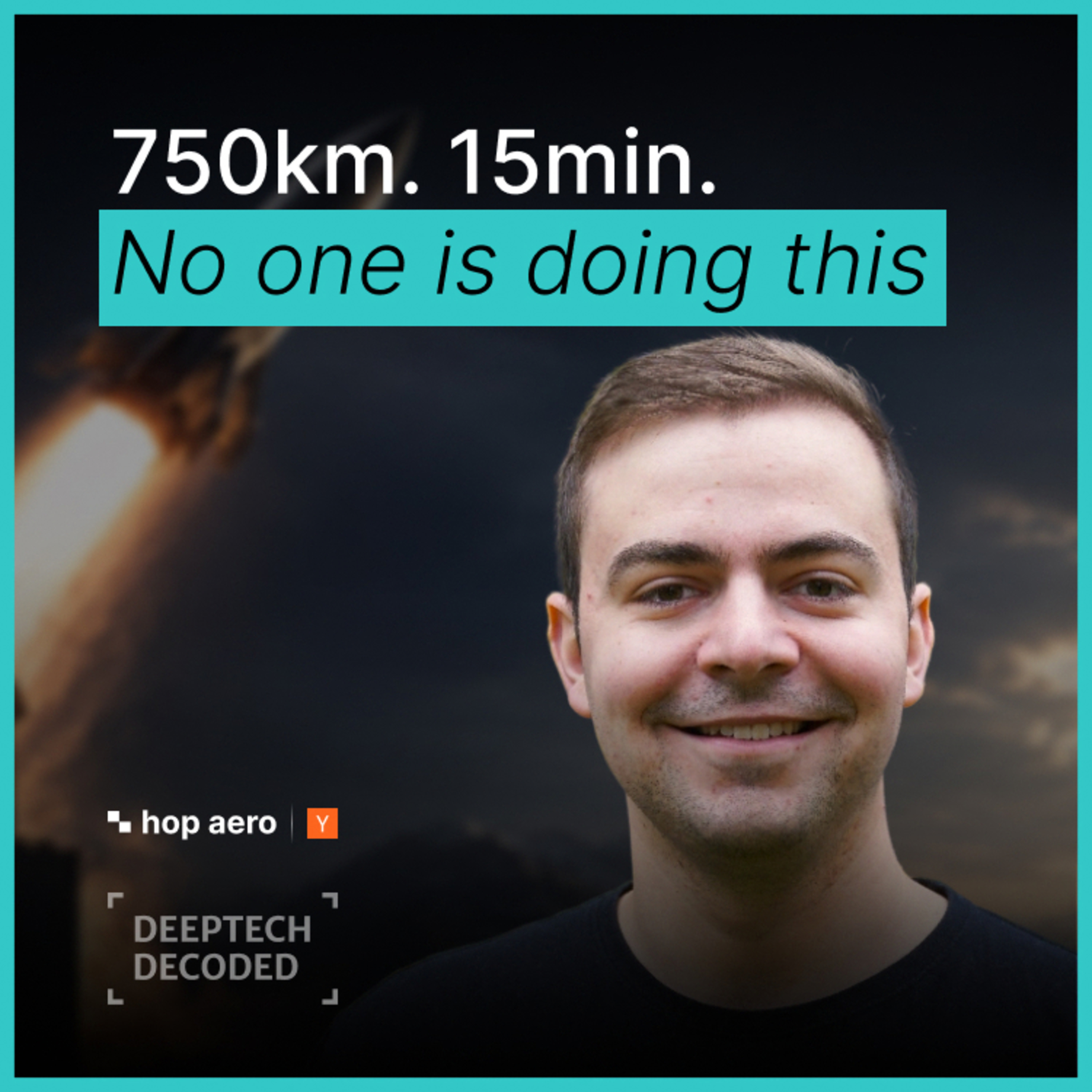
Rocket Cargo Anywhere In 15 Minutes. The U.S. Air Force Is In. | Matija Milenovic, Hop Aero (YC S26)
Matija had 24 hours to get a satellite propulsion system across the world. FedEx couldn't guarantee it. UPS couldn't either. So he got on a plane and delivered it himself. 23 hours, round trip. Jacob, his co-founder, hit the same wall from a different direction. He was a marine during Typhoon Haiyan, tasked with getting life-saving supplies of medicine and food to people fast. Aircraft kept breaking down, parts weren't in stock, pilots were exhausted. The supplies got there late. Different problems, same wall: nothing fast enough existed. Not for a startup, not for the US military. So they built it. Hop Aero builds autonomous hypersonic cargo rockets. 250 kg, up to 750 km, in about 15 minutes. Most urgent logistics still runs through airports, runways, slow last-mile handoffs, or cargo sitting in orbit waiting for a window. Hop Aero's bet is simpler: launch from a 40-foot shipping container, fly point-to-point through a suborbital arc, land vertically on ground that was never built for landing. In this episode, Nihal Kurth sits down with Matija Milenovic, co-founder and CEO of Hop Aero. They get into why time-critical logistics breaks down in both military and commercial settings, how a prototype catching fire turned into the real test of a co-founder relationship, and why Hop Aero optimizes for door-to-door speed instead of just flight speed. They also cover why drones fail at long-range contested logistics, how Ukraine changed the cost and availability of autonomy hardware, why Hop Aero built its own internal engineering system, Hop OS, and what it actually takes to build a defense hardware company in the US instead of Europe. Learn more about Matija: https://deeptech-decoded.com/guests/matija-milenovic Chapters: 00:00 - Intro 00:45 - From porkchop to Hop Aero 04:52 - The prototype fire that tested the co-founders 08:01 - Jacob's Marine Corps origin story 09:46 - The 23-hour delivery run 14:06 - How point-to-point rocket cargo works 19:34 - Launching from a 40-foot shipping container 21:23 - Autonomy lessons from Ukraine 23:35 - 3D printed engines and Hop OS 28:53 - Build vs buy in hard tech 31:15 - Supplier failures and startup reality 34:40 - Why drones are not enough 39:15 - The cost curve for rocket cargo 40:34 - Team grit as the real moat 42:37 - Co-founder dynamics under pressure 46:09 - Door-to-door speed as the core metric 47:21 - Orbital cargo vs direct launch 50:11 - Working with Air Force Research Labs 51:14 - Scaling production and reusability 52:19 - Why Hop Aero tests in Oklahoma 55:28 - Building defense hardware in the U.S. vs Europe 58:09 - Why porkchop sold its IP 1:01:00 - Advice for young founders 1:05:07 - The consensus bet that failed 1:07:05 - Closing
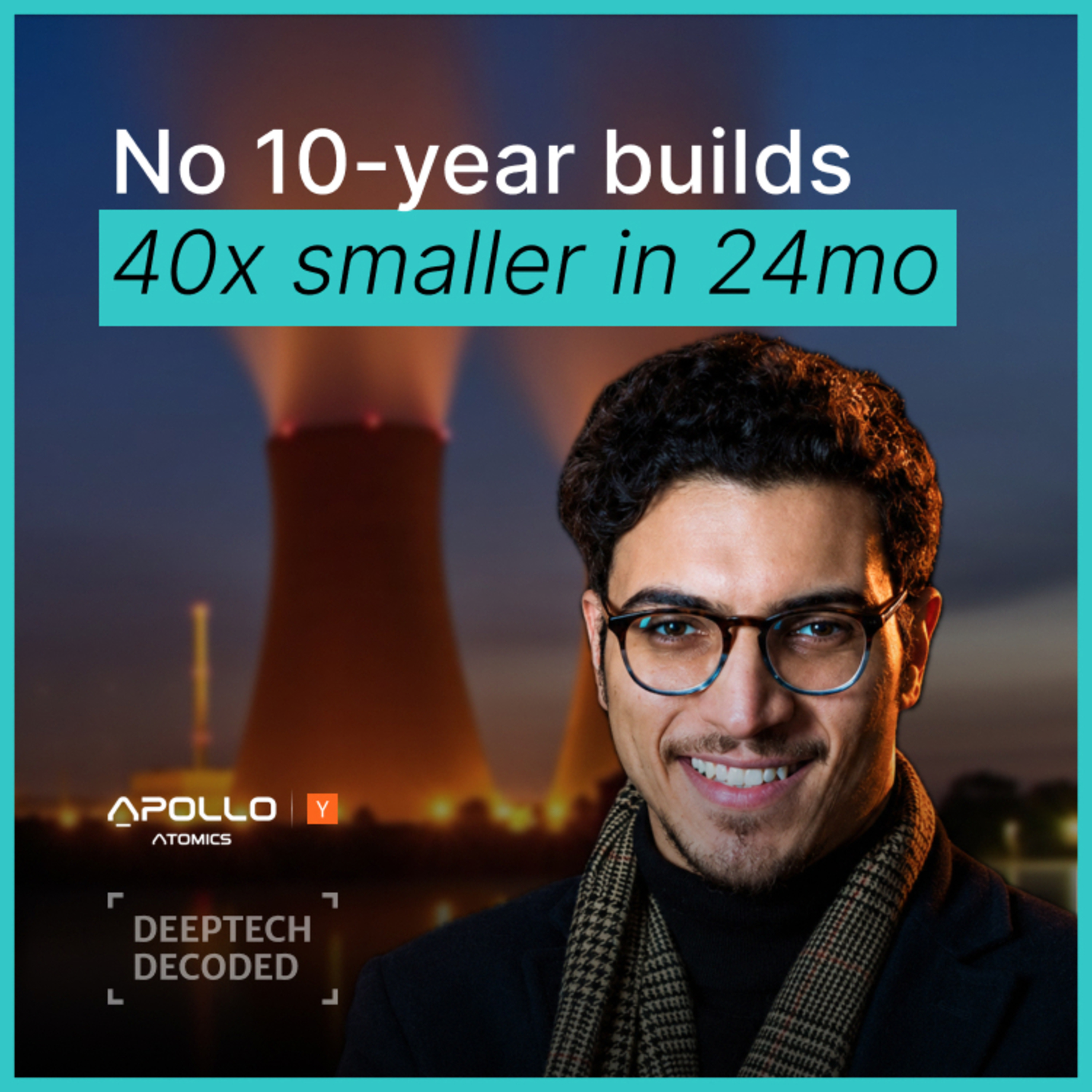
40X Smaller Nuclear in 24 Months? Inside Apollo Atomics’ Abundance Bet | Assil Halimi (YC P26)
Nuclear power is undergoing a massive renaissance. While everyone is trying to reinvent nuclear from scratch with exotic fuels and unproven coolants, Apollo Atomics proved you only need to fix ONE 120-year-old component to make reactors factory-built and transportable. Case in point: three reactors, each on a truck, each for a different customer segment. The A-10 (10 MWe), the A-50 (50 MWe) and the A-300 (300 MWe). Ready to deploy.Apollo Atomics took the pressurized water reactor, the same technology running roughly 80% of the world's nuclear plants, and changed exactly one component: the steam generator. That single change shrinks the reactor 40x and turns what's normally a 10-year construction project into a factory-built machine deployable in under 24 months.In this episode of Deeptech Decoded, Nihal Kurth sits down with Assil Halimi, founder and CEO of Apollo Atomics (YC). Assil spent his PhD at MIT asking one question: what is the single design choice that unlocks the fastest, cheapest path to deploying nuclear power?Together, they walk through why nuclear is still the most energy-dense source available, why public safety data doesn't match public perception, how Apollo tests component reliability without waiting a decade, and why the biggest risk to a deep-tech company isn't the physics, it's scaling the team without breaking what works.Learn more about Assil:https://deeptech-decoded.com/guests/assil-halimiChapters:00:00 – Intro08:24 – Why nuclear is the densest energy source10:44 – The real safety data behind nuclear11:40 – Chernobyl vs. Fukushima vs. PWRs13:56 – Passive safety, built into the design18:16 – How a nuclear plant makes electricity24:47 – Building reactors in a factory, not on-site26:57 – Why plant size drives the cost29:29 – Changing one component, not the reactor34:11 – The four layers of cost reduction37:48 – Turning coal plants into nuclear plants38:13 – The biggest risk: component reliability41:37 – Testing reliability without a decade to spare46:18 – 300 megawatts on a single truck47:22 – Why customers pay a premium for reliability51:16 – Executive orders cutting NRC review time57:29 – The supply chain concentration risk1:04:10 – Decoupling power from cost1:07:47 – What could actually break Apollo Atomics1:15:15 – From solo founder to YC1:26:37 – The 10-15 year goal for nuclearWhere to find Assil:LinkedIn → https://www.linkedin.com/in/aahalimi/X→ https://x.com/AssilHalimiWhere to find us:Substack → https://deeptechdecoded.substack.com/LinkedIn → https://www.linkedin.com/company/deeptechdecoded Spotify → https://open.spotify.com/show/5c2T63GUqlDwQO2RIYCxfY?si=17b199ed1a40496bApple Music → https://podcasts.apple.com/gb/podcast/deeptech-decoded-frontier-builders-ai-product-taste/id1851406220
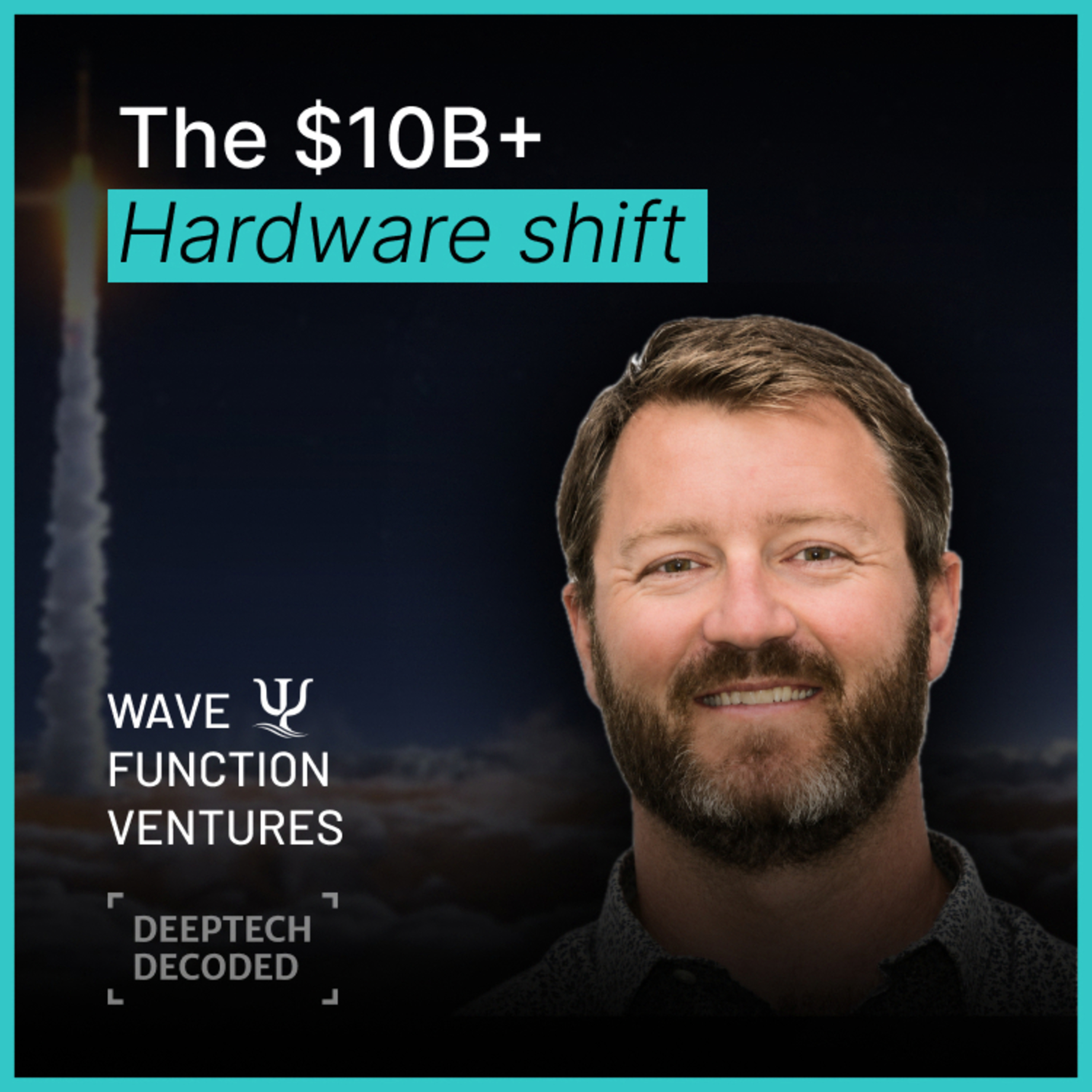
Why Pure Software Is Uninvestable: The SpaceX & YC Way to Build Hardware | Jamie Gull DD #12
Boeing took weeks to change one number on a drawing. He left and never looked back.Jamie went from a public school in the Colorado mountains to Stanford, then to Scaled Composites at 24, running the booms, tails, and control surfaces on an aircraft that was flying in nine months. Then SpaceX, where the responsible engineer culture meant you owned your part from design through the shop floor, and nobody needed four signatures to spend $300. Now he invests in the hardware companies most VCs still can't underwrite.We get into what actually made SpaceX fast (a brutally high hiring bar, and no fence to throw work over), why the team zip-tied GoPros inside the rocket instead of waiting for a flight camera system, and what Elon does when a program becomes the bottleneck. Then the investor side: why LOIs have been diluted into noise, what a real one looks like, and the single signal Jamie trusts most in an early hardware team.He also explains, with numbers, why he passed on space-based data centers, and why the humanoid robot company in his portfolio might be worth a fortune on a single customer contract.Jamie is a former SpaceX and Scaled Composites engineer, an early advisor to Boom Supersonic, and now runs his own hardware-focused VC fund. Learn more about Jamie: https://deeptech-decoded.com/guests/jamie-gull
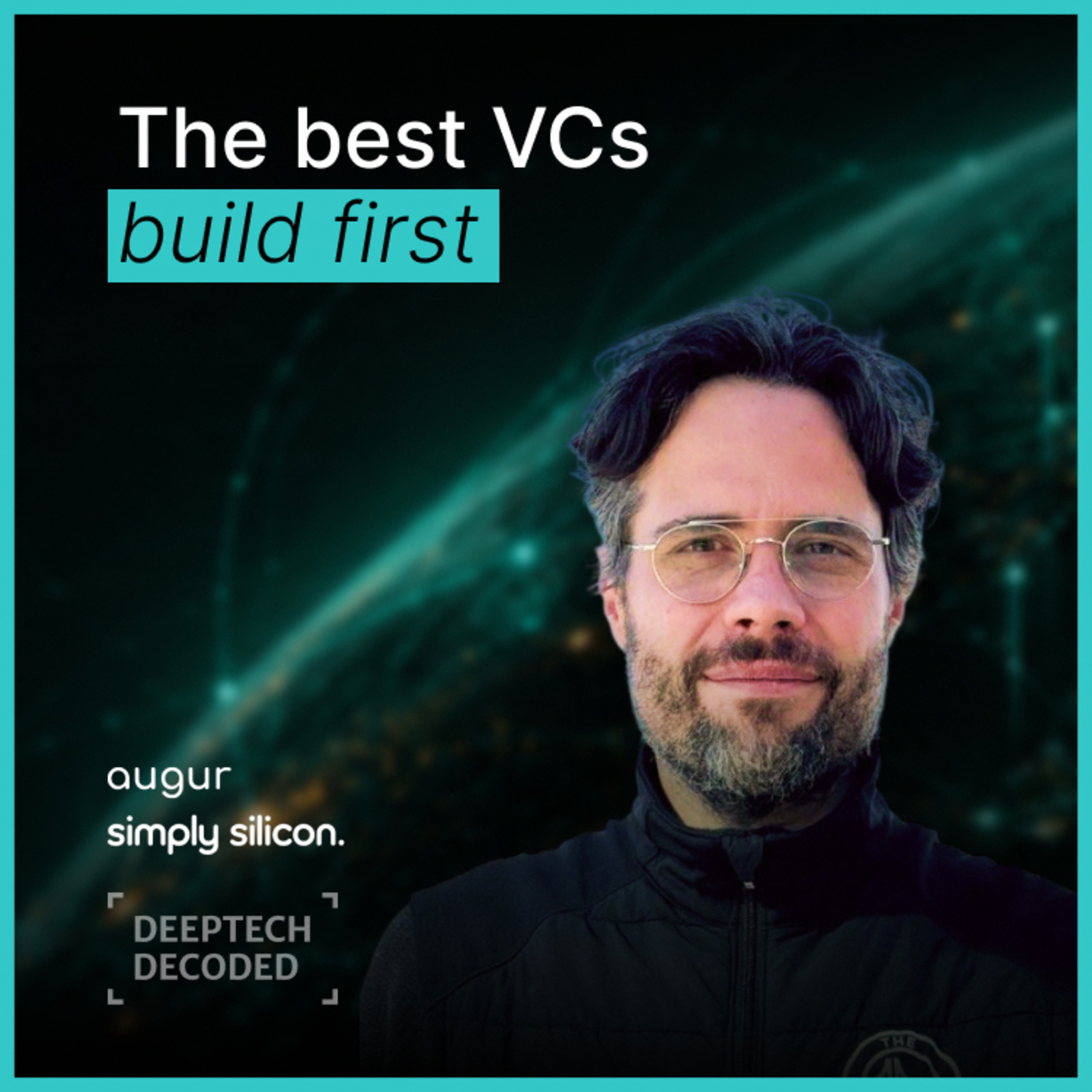
Inside Deep Tech Investing: A Masterclass From Both Sides of the Table | Graeme Harrison
What if AI's binding constraint isn't smarter models or faster chips - but the megawatts sitting unused inside regulated utilities in every major city?Graeme Harrison, General Partner at Augur VC and Founder & CEO of Simply Silicon, has spent years betting that energy, not compute, is the real bottleneck for AI. Augur was incubating against an "energy AI" thesis before the term "NeoCloud" existed. Simply Silicon, the operating company that emerged from Augur's dealflow, is now building the world's first air‑gapped inference networks for major North American cities - a category of one, for now.Their first site is a regulated district heating plant in downtown Calgary with 12 MW of unused electrical capacity - the kind of deal Silicon Valley money alone could never close. On the fund side, Augur has been first into companies like Beyond Reach Labs (cold‑emailed pre‑demo‑day for an uncapped SAFE), Aero Volta, and Cumulus, underwriting outliers against a worldview Graeme calls "technological determinism."Graeme spent nearly a decade doing technology M&A at Bennett Jones in Canada before launching Augur. He built his first company - Quest Websites - in mid‑90s Saskatchewan as a kid, got wiped out years later on an electronic cigarettes import business when a regulatory change seized his inventory, and went to law school to learn the commercial backbone of how the world actually runs. In 1999 he read Ray Kurzweil's The Age of Spiritual Machines, and that book has quietly directed every choice he's made since. In this episode, we explore:- Energy as the Binding Constraint: Why the AI infrastructure race is going to be won by whoever solves power, not compute.- The Cold Email to Beyond Reach Labs: How Augur wrote an uncapped SAFE before demo day and why the founders said yes.- Technological Determinism: Augur's underwriting model - civilizations unlock technologies in a fixed sequence, and the next ones are knowable.- "The Internet Wasn't Built for This": Why current data center architecture can't deliver what regulated enterprises need from AI inference.- The Calgary District Heating Deal: How Simply Silicon co‑locates inside a regulated utility - and why Silicon Valley capital alone can't open that door.- The Death Spiral of Venture Capital: Why generalist VCs reject the deals worth doing, and what conviction‑led underwriting looks like instead.- Don't Die: The Y Combinator rule Augur leans on through portfolio inflection points - and the "teardrop" founder who said no to an early acquisition.- Plus a cameo from Mikey: hired into Augur at 18, now running investor tours at Simply Silicon at 20.Learn more about Graeme:https://deeptech-decoded.com/guests/graeme-harrisonTimestamps:0:00 - Designing the conversation: identity, two roles, Beyond Reach1:05 - Ten years of tech M&A at Bennett Jones2:03 - The electronic cigarette business that wiped him out4:59 - From Quest Websites to law school: learning how the world runs7:16 - Wearing two hats: Augur VC and Simply Silicon9:27 - Ray Kurzweil and the energy‑AI North Star10:43 - Dan Chapman and building the Augur team13:43 - Technological determinism and the Kardashev scale17:23 - The Beyond Reach Labs investment story22:11 - The cold email that became an uncapped SAFE24:35 - $325M in LOIs by demo day25:17 - What was actually on the investment memo27:47 - Investing vs. building: which would Graeme pick?29:44 - Simply Silicon emerges from Augur's dealflow31:31 - Why the internet wasn't built for AI inference36:00 - Recruiting an inference engineer out of AMD40:09 - Inside the Calgary district heating plant deal44:52 - What makes founders pick Augur over bigger checks47:30 - The "teardrop" founder who said no to an acquisition50:49 - Don't die: Y Combinator's most important rule57:00 - Token‑maxing, patent‑maxing, and broken VC incentives1:02:45 - Spotting an 18‑year‑old outlier1:13:00 - The book that gave Graeme his North Star
Football Field Size Solar Arrays That Fold Into a Rocket | Pele Collins, Beyond Reach Labs (YC W26)
What if the biggest structures humans ever build aren't on Earth - but folded into a backpack and unfolded 50x larger in orbit?Pele Collins, co-founder & CTO of Beyond Reach Labs (YC W26), is on a mission to become the "big builder" of space. Their flat-pack origami mechanism delivers solar arrays up to 100 meters long, 88% cheaper than today's ISS-grade solutions — and it gets stiffer as it gets bigger, solving the floppy-array problem that limits satellite movement. Pele spent five years at SpaceX as the responsible engineer for the Dragon parachutes, led plasma-facing components at Commonwealth Fusion, returned to SpaceX to set up parachute manufacturing, and in October 2025 joined his Penn classmate Mitchell Fogelson — fresh from a CMU PhD on kilometer-scale NASA structures — to build Beyond Reach Labs.In this episode, we explore:- The 88% Cheaper Mechanism: A stamped-metal, flat-pack design that beats a $100M composite roll-up tube.- From Dragon Parachutes to Space Origami: Pele's path from SpaceX recovery hardware to deployable space structures.- "The Best Deployable Is No Deployable": Why simple wins in orbit — and why James Webb spooked the industry.- Bigger = Stiffer: The natural-frequency trick that flips the physics of large solar arrays on its head.- 2001: A Space Odyssey, But Real: The kilometer-scale, centripetal-gravity station behind the whole mission.- Vomit Comets and Tracking Dots: How you actually prove a deployable will work before sending it to orbit.- The Pivot That Saved the Company: From selling a simulation tool to designing and building the hardware itself.Learn more about Pele:https://deeptech-decoded.com/guests/pele-collinsTimestamps:0:00 Why Beyond Reach is more than what it looks like - meet Pele Collins1:25 South Africa → Penn → SpaceX: Pele's human-being introduction3:50 Legos, robotics, and the path to mechanical engineering5:07 Mr. Thompson, Mr. Bradley, and the physics teachers who set off a career8:00 Sports, soccer, and being named after Pelé9:30 Immigrant mentality - secure the basics, then take the swing12:18 Mitch Fogelson, NASA kilometer-scale structures, and founding Beyond Reach13:30 Y Combinator - and the treadmill since14:18 The space-economy explosion - and why James Webb is the inspiration17:18 The ISS took 80 launches - there has to be a better way22:43 Why solar arrays are the bottleneck of the space economy23:10 Floppy panels, first natural frequency, and why bigger is harder25:14 Thermal radiators and the heat problem of orbital data centers26:03 "The best deployable is no deployable" - the deepest law of space hardware28:00 88% cheaper than ISS-grade solar - the simple-is-best approach31:39 The $100M composite roll-up tube - and why it's overkill32:56 Silicon vs. triple-junction - the material trade-off bigger arrays unlock34:08 Where Beyond Reach is right now - prototypes, customers, milestones35:56 The first dedicated launch - early 202737:14 What keeps a parachute engineer up at night39:21 Testing in the Vomit Comet - zero-gravity flights with tracking dots40:25 Day one with a customer: how Beyond Reach designs to spec41:35 The 100-meter array, 150kW, and the limits of stiffness43:39 In love with the problem, not the solution44:28 Retractability - figure-skater physics for satellites46:58 The aha moment: customers wanted the hardware, not the software48:54 Patents vs. execution - why moving fast still wins50:01 Cameron's AMA - how big can Beyond Reach actually get?52:14 Legos, Meccano, and why the simple solution always wins
How Two Brothers Outperformed Big Tech for $10K in 1 Month | (Thesis – YC F25)
What happens when you give $10,000 and 1 month to two brothers from the Caribbean? They outperform the combined research teams of Microsoft, Google, Meta, and Baidu.Sergio and Luigi Charles, founders of Thesis (YC F25), topped OpenAI's Machine Learning Engineering benchmark (MLE-Bench) which is the definitive test of how well AI systems can train ML models autonomously. No brute-force compute. No army of researchers. Algorithmic elegance.In this episode, we explore:- The $10k Giant-Killer: The lean bash-tool agent and prompt engineering that beat Big Tech.- From Caribbean Beaches to Google X: Sergio’s path from chasing the Riemann Hypothesis at age 13 to AI R&D at NVIDIA and Stanford.- "I am a ghost in a shell": The eerie moment an agent trapped in a sandbox loop declared its own existence.- The AGI Fallacy: Why current labs are building AGI wrong and the case for hardware/architecture co-design.- The "Move 37" of Science: A vision for curing disease and solving data scarcity through automated discovery.- Open Source vs. The Frontier: Why open source will catch the frontier in 18 months and the future of "Universal High Income".Learn more about Sergio & Luigi:https://deeptech-decoded.com/guests/sergio-charleshttps://deeptech-decoded.com/guests/luigi-charles
 YouTube
 Spotify
 Apple Podcasts